We're always on the lookout for new views of San Francisco and its bridges, and the Judge John Sutter Regional Shoreline provides just that. This unusual park is fairly new and still in development. A pier juts out into the bay enough for some spectacular views of the City, up-close views of the Bay Bridge foundation, and interesting views of the Port of Oakland.
View of San Francisco and the Bay Bridge
Judge John Sutter Regional Shoreline
My husband and I visited mid-week and parked in the generous and practically empty parking lot. This is a launching off place for anyone heading for the pier and fishing or views, or those planning to bike or hike the two and a half miles to Yerba Buena Island, with access to Treasure Island. The pier parallels the Bay Bridge so the traffic noise is quite loud, but the whole situation is so unique and interesting that it seemed worth it.
Map of the trail
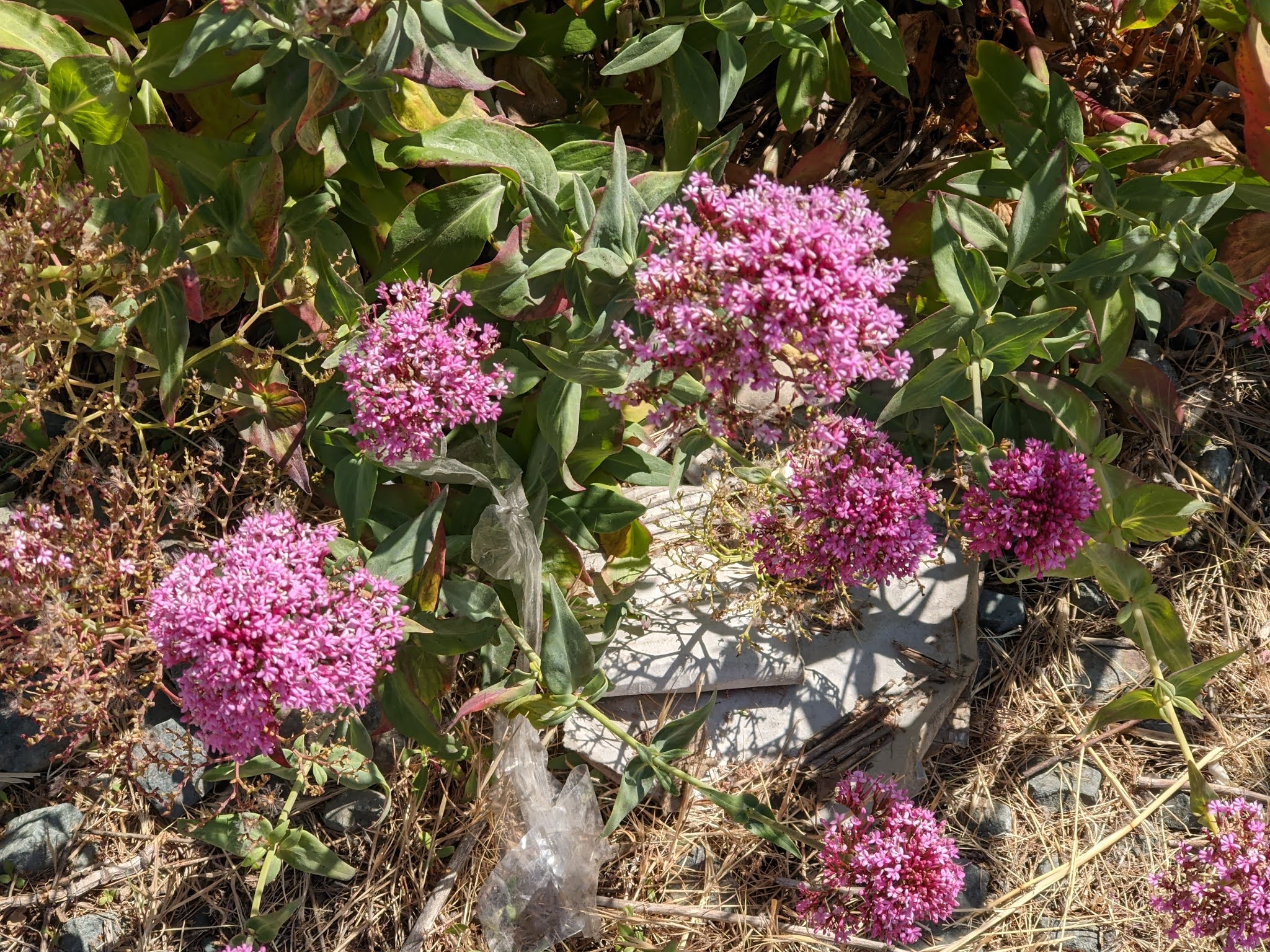
Purple flowers
The park has interesting transportation history. According to the East Bay Regional Park website:
The electric railway Key System operated on a trestle between 1903 and 1958, and carried passengers to a ferry terminal to cross the bay between the East Bay and San Francisco.
A substation at the site provided electrical power to the trains that carried 36.4 million passengers in 1945.
The Interurban Electric Railway Bridge Yard Shop Building, renamed recently to Bridge Yard Building, was a maintenance facility for the trains.
In 1941, the Oakland Army Base was established at the site as a transportation port and distribution terminal for the Department of the Army. The base was decommissioned and closed in 1999.
The Port of Oakland is right across the channel, with views of cargo ships and cranes (inspiration for the Star Wars Imperial Walkers, according to local lore). On the day we visited, the ONE (Ocean Network Express) was in port. Gotta love a pink cargo ship.
ONE - cargo ship in the Port of Oakland
Massive cranes used in the port
Pink flowers
We caught a glimpse of San Francisco through the barbed wire fence, while winding our way along the path past interesting buildings and landscape plants.
View of San Francisco from the East Bay
Interesting old building
Red flowers
The pier is built on the foundation of the old Bay Bridge, and parallels the new Bay Bridge. Benches provide places to rest, eat your lunch, and take in the view. You can fish off the pier (but cannot clean your fish there). On the day we visited, several fishermen tended their lines, hoping to catch dinner.
Section of the old Bay Bridge on the left, the new Bridge on the right
Substantial foundation for the new Bay Bridge
Photo-op from the end of the pier
It will be interesting to see how this park evolves over time! I recommend the park for its easy access, beautiful views, and fascinating history.
It's summer time! Things are opening up here in the San Francisco Bay Area after a very long year (plus) of sheltering in place. Slowly we're emerging from under our rocks into the bright sun, and from our cocoons ready to spread our wings. Traffic is heavier, some offices have opened, the neighborhood resounds with home projects. Here is a mix of summer images to kick off the season.
Containers
Instant Pot Lemonade
New Perspectives
Exploring
Puzzle Fun
Shadow Play
Summer Fruit
Summer Dyeing
Red Birds
Yellow Bird
It's time to resume our favorite activities and enjoy life away from home again (with some prudent caution). Let the summer begin!
This year we're looking for fabric dye sources right here on our residential lot in Oakland, California, as part of our "back to the land" theme. Last time we dyed with camellia petals: pink (a bust) and red (a success). See Dye Project: Camellia Petals.
Today I'm dyeing with tulip tree flowers. What I call a “tulip tree” is actually a magnolia, and most likely a Magnolia x soulangeana cultivar, which is a cross between Magnolia liliiflora and Magnolia denudata. We have a mature tulip tree in our yard, and many in the neighborhood. I couldn’t find any information about dyeing with tulip tree flowers, so not sure what to expect.
For this project I used basic dye equipment, and a well-ventilated workspace. I used a soaking pot, a dye pot, a heat source, and a candy thermometer to keep the dye bath at a consistent temperature. I also used a strainer and cheese cloth to remove the petals from the dye bath. Supplies include:
NOTE: For safety, use a face mask and rubber gloves.
Outdoor studio and basic equipment
Prepared cotton fabric (dish towels, napkins, and handkerchiefs)
The Weight of Fabric (WOF) was about 9 ounces (259 grams). I typically dye dish towels, but this year I’m expanding to other cotton items. For this batch I used:
2 dish towels
2 napkins
2 large handkerchiefs
2 small handkerchiefs
Tulip tree flowers (Magnolia x soulangeana cultivar)
Collecting and freezing tulip tree flowers
I collected about 28 ounces of tulip tree flowers, so, the WOF% for 9 ounces of fabric was about 311%. I gathered the flowers throughout March, and froze them to preserve the color. Tulip tree petals are very thick and spongy. It doesn’t take long to gather quite a few petals. The supplies for the project include:
28 ounces tulip tree flowers
1/2 lemon
A gallon of water
9 ounces prepared cotton fabric
Extract the Dye
First, extract the dye, using our basic process:
Add petals and lemon to the pot.
Simmer for an hour.
Soak petals.
Strain them.
Rinse tulip tree petals in water to clean them
Rinse the petals to remove dirt. Add the petals to a gallon of water in a stainless-steel pot. Stir in juice of 1/2 lemon and its rind.
Tulip tree flowers in dye bath with lemon
Bring to 180-200 degrees, and simmer for an hour. I have read that the temperature should be kept between 160-180 degrees for flowers and leaves. My equipment isn’t that fine-tuned, so I’ll use our basic extract process, and see if it works. Soak petals and lemon rind for three days.
Spent tulip flowers
Strain petals out of the dye bath using cheesecloth. Return the dye bath to the stainless-steel pot. The resulting liquor is a brownish orange. It has an odd fragrance that is difficult to describe. Maybe like soap.
Tulip tree flower dye bath
Dye the Fabric
Then, dye the fabric using our basic process:
Add wet fabric to dye bath.
Heat the dye bath and simmer for an hour.
Soak fabric in the dye bath.
Rinse and hang to dry.
Add fabric to dye bath
Add wet, prepared fabric, and simmer for an hour, keeping the temperature between 180-200 degrees. Stir periodically to make sure dye is distributed as evenly as possible.
Rinse fabric until water runs clear
Air dry fabric
Let soak for an hour or overnight. For saturated color, I let it soak for three days. Squeeze out excess dye from the fabric. Rinse the fabric in cool water until the water runs clear. Run the fabric through the washing machine rinse and spin cycles, using cold water. Let the towels air dry. Two weeks later, wash the towels in pH neutral soap, like Synthrapol, and hang to dry.
Lemony-yellow dye results
The resulting color is a cheerful lemon yellow.
Learn More:
The Handbook of Natural Plant Dyes, by Sasha Duerr