Home Page

Showing posts with label green roof. Show all posts

Wednesday, June 24, 2020

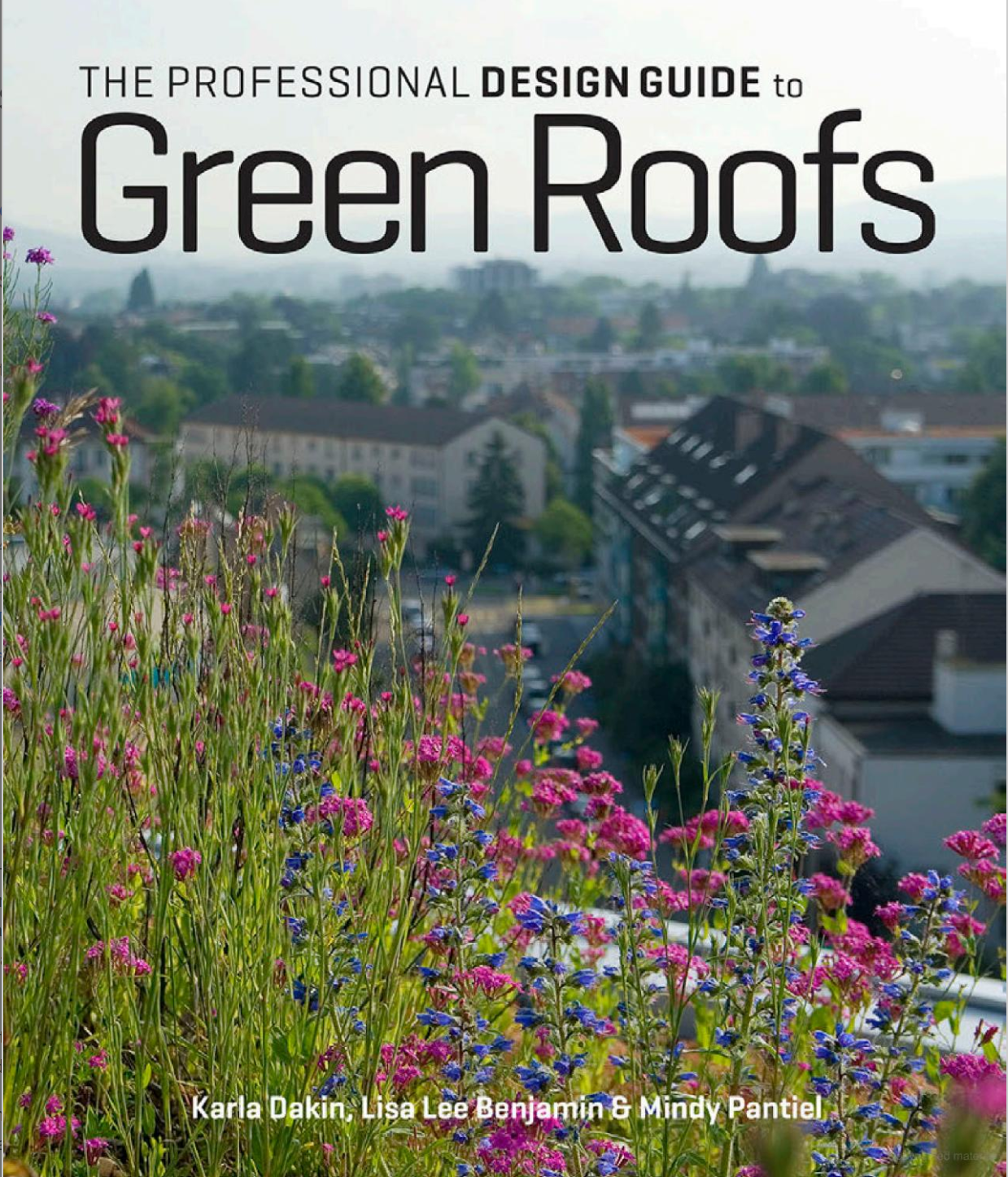
The Professional Design Guide to Green Roofs

I picked up The Professional Design Guide to Green Roofs at the San Francisco Garden Show several years ago, after attending a presentation by two of its authors. Green Roofs was written by Karla Dakin, Lisa Lee Benjamin, and Mindy Pantiel, and published by Timber Press (Portland, Oregon 2013). The authors are professional landscapers with portfolios of significant roof top and ground-based landscape projects, and a network of roof top landscapers around the world.


Green Roofs is comprised of two sections. Part One: Inspiration—Form and Function describes finding inspiration for designs from nature and culture. Chapters include Shapes and Patterns, Creating Living Spaces, Wildlife Friendly Spaces, and Plant-Driven Environments. Part Two: Process focuses on project management for the professional landscaper. Chapters take the reader through the processes of predesign, site analysis, client program, planning and conceptual design, design development and construction, and contracts, construction, and maintenance. The final chapter, The Evolving Frontier of Landscape Design, casts vision for the future of roof top gardens in the urban landscape. The back matter includes a bibliography, acknowledgments and credits, a chart of USDA climate zones, and a thorough index.

The book is filled with beautiful photographs that illustrate concepts and serve as a portfolio of projects installed by the authors and other green roof landscapers. Their projects include both living spaces and living meadows, depending on the weight the roof can bear. I especially appreciated learning about the the move toward providing green roofs in the urban settings for practical reasons, like filtering rain water, lowering the heat island effect, and providing a habitat for pollinators and migrating birds (imagine an aerial wildlife corridor through busy cities where migrating birds can touch down for rest and nourishment). Green roofs can also provide a space for city dwellers to seek respite from urban life, and enjoy fantastic views.

I was also pleased to see some favorite titles in the bibliography, like Thomas Church's Gardens are for People; Theodore H. Osmundson's Roof Gardens: History, Design, and Construction; and Tim Richardson's Futurescapes: Designers for Tomorrow's Outdoor Spaces (as well as many other new titles to explore). With a growing population and spreading cities, the ancient idea of green roofs is a timely vision for the future.

Wednesday, July 11, 2018

Dry Creek Garden

On one of our hot, summer weekends, my husband and I visited Dry Creek Garden in Union City. It is part of Dry Creek Pioneer Regional Park, and closely associated with Garin Regional Park in nearby Hayward. The Meyers sisters (Edith, Mildred, and Jeanette) donated 1200 acres from Dry Creek Ranch to the East Bay Regional Park District to create Dry Creek Pioneer Regional Park.

Nearby wheat field

Dry Creek Pioneer Regional Park

Their father, Henry H. Meyers (1867-1943) was an architect here in the Bay Area, and designed some landmark sites such as the Posey Tube, Highland Hospital, and Caldecott Tunnel. He also designed the family home in Alameda  Meyers House and Garden.

Gate post for Dry Creek Cottage

The three daughters were successful in their own right. Edith (1900-1971) became a pediatrician, and served as staff president at Children's Hospital. Mildred (1898-1982) studied architecture at U.C. Berkeley, passed the state exam in 1926, practiced with her father until his retirement in 1936, and then took over the practice. Jeanette (1905-1993) ran Dry Creek Ranch.

Fountain in the wild

Shady path through the oaks

My husband and I spent a leisurely hour in the shady Dry Creek Garden. We followed meandering paths, crossed charming bridges, explored the kitchen and rose gardens, enjoyed watching the free-range chickens forage for food, and sat on on various benches to observe nature.

My Example
Chinese lantern

Free-range chickens

Flower garden

More flowers

The two-acre garden is rather wild and tangled, with many interesting native and exotic plants and trees. Dry Creek is lined with wonderful stonework, and, unexpectedly, contained some water. Meyers Cottage is very charming and set in a shady stand of trees. It's easy to see why the Meyer family would gravitate to Dry Creek as a summer home.

Meyers Cottage surround by trees

Dry Creek (with a little water)

Follow the May Trail through shady oaks to access a 27-mile network of trails. Take the Ridge Loop Trail or the High Ridge Loop Trail for the views. Take the Dry Creek Trail for a mile to the southern tip of Jordan Pond in Garin Regional Park. Be sure to close the gate, since these hills are still used for cattle!

Cattle gate

Wednesday, January 31, 2018

Garden on the 17th Floor


While exploring some of the downtown districts in Seattle we had the opportunity to visit the Russell Investments roof garden at 1301 Second Avenue. This is a privately-owned garden on the seventeenth floor that is made available to the public during business hours.
Russell Investments rooftop garden on the 17th floor


You can bring lunch and eat outside with fantastic views of the city and the sound on three sides, or purchase lunch in the small cafeteria. When we visited, the cafeteria was closed and access to the garden was blocked for holiday maintenance, but we could still enjoy the views and garden design from within. The sun broke through after days of drizzly rain, so we were treated to very dramatic skies and lighting.
View of the sound from the rooftop garden

City view from the rooftop garden

The garden resembles a prairie or coastal scene with several “big bonsai” trees, golden grasses, low shrubs, and slate and wooden pathways. The sculpture of an abacus in steel and green glass is especially fitting for an investment company. The overall design calls to mind a modern interpretation of nature, using plants and materials from the Pacific Northwest. You can see this design in this aerial photo posted by Reed.

Roof garden design from above (posted by Reed)

We already have plans to visit the garden for lunch on our next trip in warmer weather. Roof gardens in urban centers help reduce heat emission from the roof, provide habitat for people and birds, and are a pleasure to view in an industrial setting. After our visit we headed over to Kizuki Ramen & Izakaya in Capitol Hill for conversation over delicious ramen noodles in steaming broth.

Wednesday, October 9, 2013

On the Roof at MOMA

I am always on the lookout for roof top gardens. They can be elaborate and extensive, or a quiet and private space. On one of our son’s visits home from University of Alaska, Anchorage, we visited the San Francisco Museum of Modern Art (or MOMA) to view their art collection. The building was designed by Jensen Architects (an international firm based in San Francisco), and is very distinctive.

One of the fun discoveries was the Carolyn and Preston Butcher Garden Terrace, with its roof top sculpture garden and small coffee bar. We spent part of our MOMA visit on the roof, enjoying the combination of closed and open air space, and interesting sculptures. I also enjoyed the chance to study the raised planting areas and choice of vegetation. It was simple, yet very satisfying.

Carolyn and Preston Butcher Garden Terrace (MOMA) - raised bed

The museum closed earlier this summer for a three-year renovation project. See their web site for information about their off-site exhibition this fall (http://www.sfmoma.org/). You can catch a glimpse of the Garden Terrace in the short video “Trailer for Stories from the Evacuation” (fast forward to 1:11).

Sunday, August 19, 2012

Denali National Park

For a short, three-day road trip, my husband, folks, and aunt rented an SUV and drove the Parks Highway to Denali National Park. The forecast of cloudy and rainy weather dimmed our hope of actually seeing Denali, but we decided to go anyway, since the terrain and wilderness is beautiful on its own merit. Plus, the “partly cloudy” weather prediction could also be read as “partly sunny”, meaning we could have a brief encounter with Denali. Denali, which means “The High One” (formerly known as Mount McKinley), is 20,328 feet high and the tallest mountain peak in the United States and North America. Denali National Park includes more than six million acres of raw, wild land. What a national treasure.


Our upscale camp site at the Cantwell RV Park.

On a tip from friends in Wasilla, Alaska, we rented trailers in the Cantwell RV Park for our lodging (Milepost 210). This was great fun, and provided us an “upscale” camping experience, without having to haul around camping gear or drive an RV. In the Park (Milepost 237.2), we signed up for shuttle service to the Eielson Visitor Center, an eight-hour round-trip ride with brief restroom breaks and frequent stops for wildlife viewing. This is a great way to see the park – letting an expert drive, with the option of getting off and on the buses. Our driver informed us that Denali is so tall that it makes its own weather, and that only about 30 – 40% of Park visitors actually see the mountain.

It is hard to fathom the distance and grandeur from a photo.


Our green shuttle making a stop to view wildlife and the terrain.

Our shuttle left the Wilderness Access Center (WAC) at 10:30 in the morning. We had a great ride and a very knowledgeable bus driver. We saw lots of wild life – grizzly bears, caribou, foxes, wolves, mountain sheep, hawks, magpies, chipmunks, and a seagull. We saw beautiful sweeps of tundra, with its tapestry of miniature plants and jagged mountains.

Caribou
Tundra tapestry
Miniature fireweed
Grazing grizzlies

We enjoyed the 40 minute break at the Eielson Visitor Center with its sod roof, solar panels, and grand vistas. But no glimpse of Denali. The mountain was continually shrouded in clouds and mist. Our shuttle returned to the WAC at 6:15. For dinner we dined at The Salmon Bake just north of the Park (Milepost 238.4), and then returned to the RV Park for the night.

Eielson Visitor Center, with a non-view of Denali.


The sun occasionally peaked through the clouds and mist.

The next day was a beautiful – full sun, puffy clouds, and warm temperature. We drove our rented SUV back to Anchorage in high spirits. And guess what? We saw Denali. All the way to Anchorage we had spectacular views of the mountain – from the North, West, and South. Clouds drifted across the snow capped peaks but we had a clear view. I heard one fellow in the South parking lot state that he had never seen such a clear view of Denali in all his years in Alaska.


Denali from the Parks Highway – North View.

Denali from the Parks Highway – South View.

If you are ever in Anchorage or Fairbanks – go to Denali. You might get lucky and see the mountain, despite the odds, or you’ll have a great story to tell about NOT seeing the mountain.

Saturday, August 4, 2012

Green Roof in Anchorage

This green roof caught my eye in downtown Anchorage. The Visitor Information Center is covered with a meadow of local wildflowers, reminiscent of a prairie sod roof from pioneer days.


Visitor Information Center in downtown Anchorage, Alaska. 

The log cabin is also surrounded with annuals in shades of pink and purple. Annuals are very popular in a place with a short and intense growing season. The soil is rich with nitrogen so the flowers grow large and bold.


Sod roof and perennial border of bright annuals.


Wednesday, June 6, 2012

Another Terrace Garden

While on the Davenport’s Garden Terrace, I spotted another terrace garden in the vicinity. This one may not have the budget or exposure of the Davenport, but I like that they provided this planting area for the building. I wasn’t aware of the planting from the street, so it must be for the use and enjoyment of the building’s employees and visitors.
An elevated planting area in the Spokane urban landscape

Though simple, the tree and planters soften the urban landscape, and provide respite from concrete and steel girders.

Sunday, June 3, 2012

Davenport Hotel – The Garden Terrace

I love raised beds almost as much as roof top gardens, when I find them together, I’m ecstatic! While in Spokane, Washington recently, we stayed at the historic and renovated Davenport Hotel. The Davenport is beautiful, with respect for the past and a vision for the future (they have LEED Gold Green Building Certification). One of their features for hotel guests is a garden terrace on the fourth floor, over the entrance, shops, ballroom, and restaurant.


The Garden Terrace

The look is both classic and modern, with raised beds for shrubs pruned in a round shape and deciduous trees (possibly Acer spp.), and urns for columnar trees (possibly a variation of Cupressus sempervirens 'Stricta'), in contrast with the brick building of the hotel. Drip irrigation keeps the plantings watered.

Raised beds and planting urns

The terrace is protected from the wind by the hotel. In late April it was still a little chilly to sit out, but in summer or fall, this would be a great place to relax in solitude or with friends. My husband and I simply enjoyed the fresh air and view of the surroundings from a different vantage point.