Home Page

Showing posts with label plant parasites. Show all posts

Sunday, June 16, 2013

Mistletoe in Bend

While in Bend, we saw some good examples of mistletoe growing on conifers. In all cases, the mistletoe was growing on Juniper trees that grow on wild, uncultivated land, sometimes even growing right next to cultivated land. Possibly trees that receive less water are more prone to drought and infestation.

Juniper scrub plant community in Bend, Oregon
As mentioned in a previous post (“Mistletoe”), mistletoe growing on conifers produces scales instead of leaves. Scales are a leaf adaptation.

Healthy Juniper scales
Seedlings that land on the branches are capable of photosynthesis, but the adult plants are dependent on their host for nutrients from photosynthesis and as moisture.


Mistletoe growing on a Juniper
The haustoria taps into both of the tree’s transport systems – the xylem that brings moisture and nutrients up from the roots, and the phloem that distributes nutrients from the photosynthesis process.


The mistletoe leaves resemble the scales of the juniper
The mistletoe causes distortions in the conifers, called witches’ brooms.
 

Sunday, June 9, 2013

Lichen

Many people become concerned when they see lichen growing on their trees, wondering if their tree has a disease. However, lichen, like moss, is not a plant parasite. Instead, the lichen is using the structure of the tree for physical support, but is not tapping the tree for its nutrients.

Lichen and moss hitching a ride on a Rhododendron

Lichen is a composite organism, which consists of a fungus and a photosynthetic partner (such as green alga or cyanobacterium) growing together in a symbiotic relationship. This organism produces its own food via photosynthesis, and absorbs moisture from the environment.

Lichen is a composite organism, but not a plant parasite

The Integrated Pest Management (IPM) site indicates that you can use herbicidal soaps to control mosses, lichens, and algae. But, personally, I like the look of lichen and moss growing naturally on trees.

Wednesday, June 5, 2013

Mistletoe

Mistletoe is a plant parasite of trees – both deciduous and conifer. Mistletoe on deciduous trees typically attach to stems, are capable of photosynthesis, and are parasites of the xylem. Mistletoe on conifers produce scales instead of leaves; the seedlings are capable of photosynthesis, but the adult plants are dependent on their host, parasitizing both xylem and phloem. The mistletoe causes distortions in the conifers, called witches’ brooms. Mistletoes are dioecious, meaning they produce male (pollen) and female (berries) reproductive structures on separate host trees.

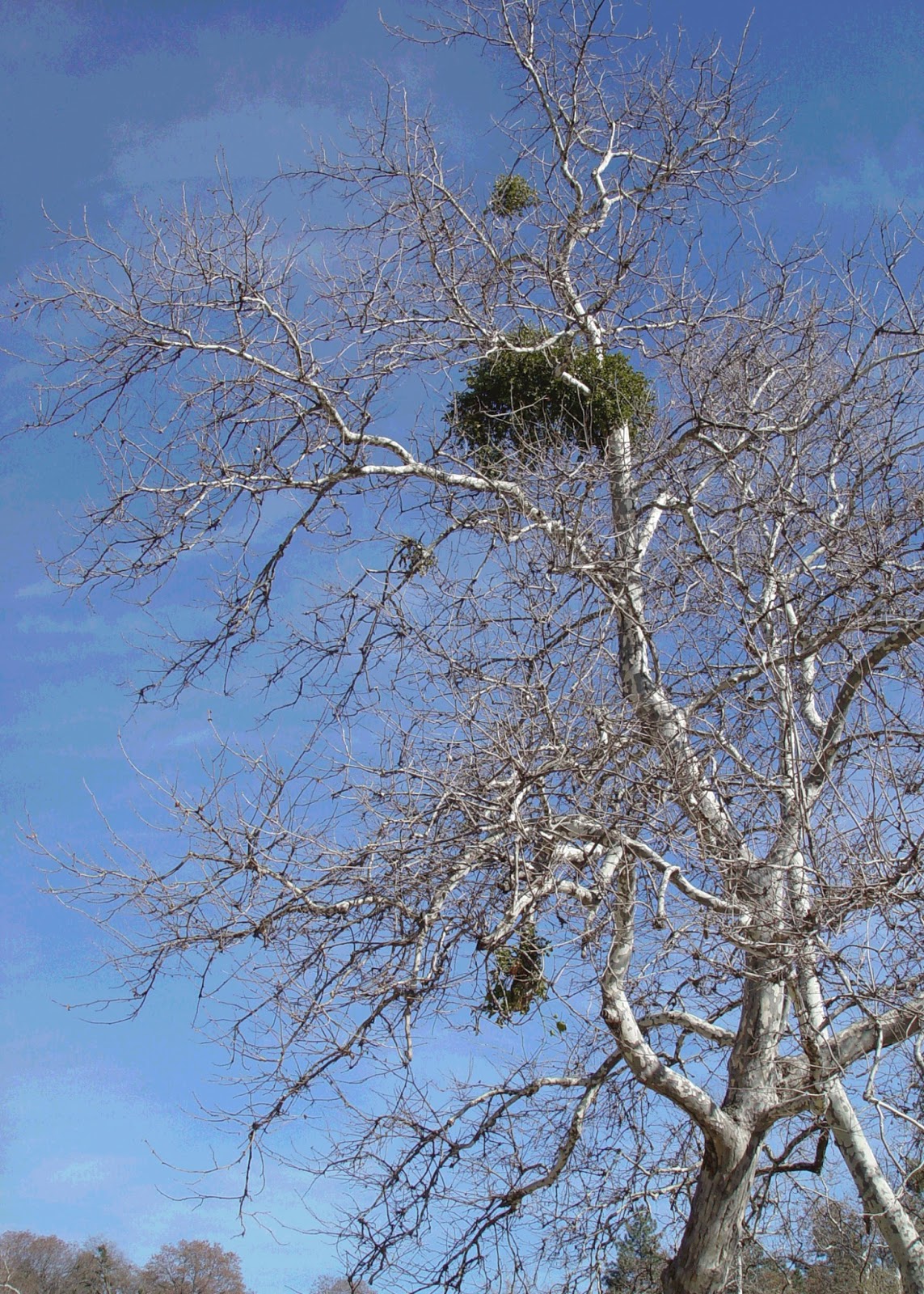
Mistletoe in a sycamore

The mistletoe is easiest to see in deciduous trees, when they have lost their leaves in the fall. The mistletoe is evergreen and appears as a leafy mass hanging off a branch. Here in the Bay Area, we frequently see mistletoe in landscape trees. Broadleaf mistletoe (Phoradendron macrophyllum) infests alder, Aristocrat flowering pear, ash, birch, box elder, cottonwood, locust, silver maple, and walnut. P. villosum infests oaks. Arceuthobium spp. infests firs and pines.

Detail of mistletoe in a sycamore tree

Birds feed on the berries and excrete the partially digested seeds, which fall on branches. When a seed germinates, it sends haustoria into the bark. The haustoria “takes root”, tapping into the xylem and/or phloem transport systems and consuming nutrients and water. The mistletoe grows slowly at first, but becomes embedded deep in the branch. The host tree may not look as healthy as uninfected trees, since it is sharing its nutrition with its parasite. A tree can support a mild infestation, but individual branches may weaken; a heavily infested tree may eventually die, especially when the tree is stressed by environmental conditions such as drought.

For management tips, see the Integrated Pest Management (IPM) site. To manage the problem you must contain its spread as quickly as possible. Prune infested branches at least one foot below the point of attachment. For infestations on a branch or trunk, this may be a problem. The IPM site recommends wrapping the area with wide, black plastic to cut off the light source for the mistletoe, causing it to eventually die. Chemical treatment with a plant growth regulator (ethephon, or Monterey Florel Brand) is possible. IPM recommends planting resistant tree species, including Bradford flowering pear, Chinese pistache, crape myrtle, eucalyptus, ginkgo, golden rain tree, liquidambar, sycamore, and conifers such as redwood and cedar. 

Sunday, June 2, 2013

Plant Diseases - Flowering Plant Parasites

For the next several posts, I’m taking a look at more diseases that affect plants. Previously we looked at bacteria; this time we're looking at flowering plant parasites that live off other plants in the Kingdom Plantae! For sources I’m using Essential Plant Pathology, the U.C Davis Integrated Pest Management (IPM) website, and information from my plant diseases course at Merritt College, taught by Dr. Ann Northrup in Fall 2012.

Plant parasites are categorized as eukaryotes, and have a fairly normal life cycle, in that seeds germinate and develop into plants with flowers that are pollinated and produce seeds. The difference is that instead of roots, the plants develop an absorption structure called haustoria, which enters an opening in a plant’s root, stem, or branch, and grows as a parasite. Seeds can exist in the ground for decades, until they are in proximity of an appropriate host.

Mistletoe growing on a Palo Verde stem
in Joshua Tree National Park

There are two main categories of flowering plant parasites (some do not fit these categories):
  • Hemiparasites – these have green leaves and can produce their own food using photosynthesis. They absorb water and minerals from their host, so are mainly xylem parasites.
  • Holoparasites – these do not produce their own food using photosynthesis, so they depend on their host for water, minerals, and nutrients. They are both xylem and phloem parasites.
There are four major types of parasitic flowering plants – broomrapes, dodders, witchweeds, and mistletoes. I’ll focus on mistletoe.