Home Page

Showing posts with label Zion National Park. Show all posts

Wednesday, March 16, 2016

Indoor Hanging Garden


Several years ago, my husband and I vacationed in Zion and Bryce National Parks in beautiful Southern Utah. We love to travel in fall, and visited in late October when deciduous trees were either bare, or sporting red and gold leaves; and only a few fall flowers were in bloom. It is difficult to beat the golden fall light, the warm days and crisp nights, and the stars.

I was especially struck with the beautiful Weeping Rock in Zion National Park. I loved how the water seeped over the rock face and dripped off overhangs; and how moss, algae, and aquatic plants clung to rocks, and were bathed in the water. At the time, I thought what a great idea it would be to emulate this hanging garden in a home or public garden (see: Hanging Gardens).

Hanging garden at a restaurant in Bend, Oregon


Last summer I saw a hanging garden in a restaurant in Bend, Oregon, that could have been inspired by Weeping Rock. Smaller scale, of course, but it captured some of the elements of the Zion National Park. I love this idea of bringing a bit of nature in doors!

Wednesday, October 31, 2012

Wildflowers of Zion National Park

I purchased a small book in the Zion National Park store called Wildflowers of Zion National Park, by Dr. Stanley L. Welsh (published by the Zion National History Association in 1990). This slim volume fit easily in my day pack, and became my go-to guide for identifying trees and plants in the Park.


The short introduction provides a summary of the Zion National Park setting, geology, climate, plant communities, and pollination. Most of the book is dedicated to descriptions and photos of wildflowers in the park, organized by color (white, yellow, pink, red, and so forth). The green section includes vines, trees, and grasses. A final reference section indicates flowers that bloom in spring (the bulk of them), and in summer and fall. According to the introduction, there are about 900 different kinds of plants in the park, but Dr. Welsh included 120 of the most common.

Since we were travelling in Zion National Park in the fall, we did not see many wildflowers. But I was able to identify a few blooms from the book, including Rubber Rabbitbrush (Chrysothamnus nauseosus), Utah Daisy (Mirabilis multiflora), Globemallow (Sphaeralcea grossulariifolia), and Palmer Penstemon (Penstemon palmeri).

Sunday, October 28, 2012

Using Local Material

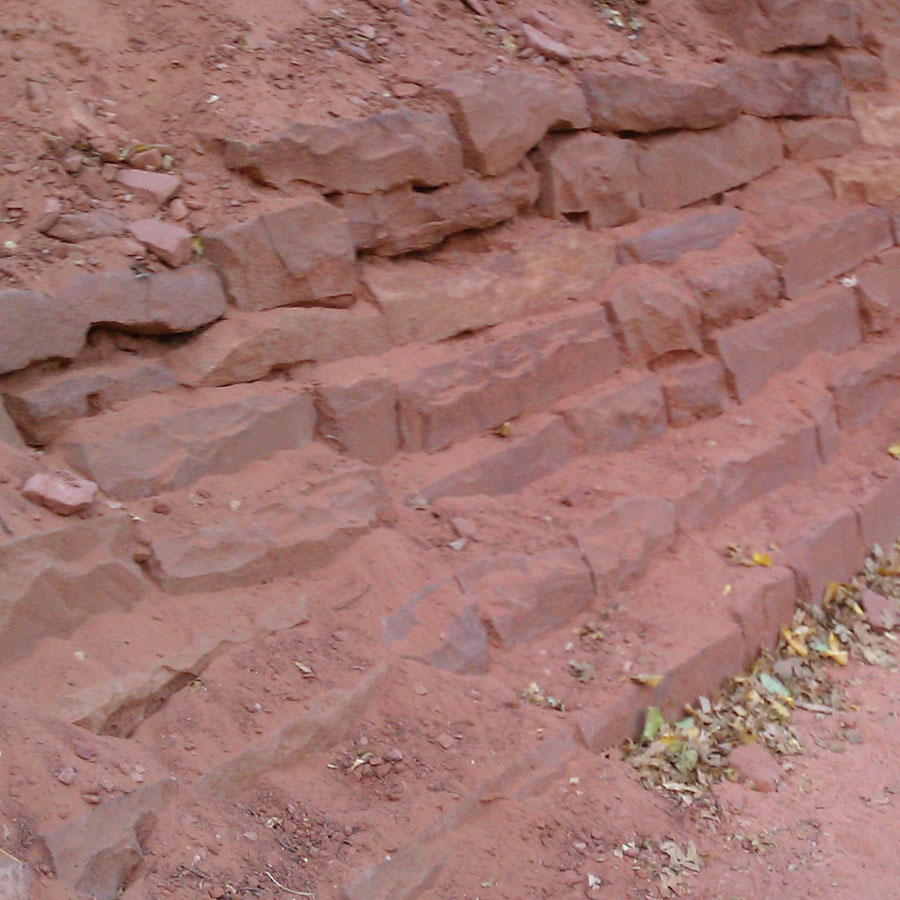
I love the red rock of the Zion and Bryce National Parks, and its permutations of yellow or white, depending on which mineral leached into the porous sandstone over the millennium. I also love seeing how the Parks and the local communities work these local building materials into the landscape and garden design.

Photo op of the Virgin River - the red stone retaining wall
blends with the surrounding landscape.

We saw many examples of this in both Parks. The roads in the park are colored red (very useful for determining when you are in or out of the park); and red rock is worked into the landscape as rocks, bricks, drainage ditches, retaining walls, and bench supports. I have seen this done well in other regions as well. In Alaska, folks use slate and granite; in the San Francisco Bay Area we use volcanic rock; in Spokane, they use basalt columns and polished river rocks.

Red rock retaining wall.
Freestanding red rock wall.
Red rock bricks around a drainage ditch in Springdale, Utah.
Red rock bricks used on a bench in Springdale.

The rocks and bricks come from a small local quarry, providing employment and building materials with a sense of place.

Chisel markings for a large rock brick.
Large rock bricks waiting for use or further sculpting.

Wednesday, October 24, 2012

Park Service Innovation

We saw an innovative heating and cooling system implemented in the Zion National Park visitor center. I am always on the lookout for creative solutions to everyday problems – like how to heat and cool a space without using fossil fuels. I especially like regional solutions, which use the resources at hand.

Zion Nation Park visitor center, with its
tall cooling towers.

The visitor center design uses wind, water, and sunlight to cool in the summer, and heat in the winter. In the summer, the tall cooling towers capture outside air, which flows over wet baffles and then sinks and cools the building. In the winter, heat from the sun is captured passively in a south facing “trombe” or heating wall, and radiates naturally into the building, where it rises and warms the building. You can read more about their environmentally friendly visitor center on the website: http://www.zionnational-park.com/zion-national-park-visitors-center.htm

Signage provides a description of the heating and cooling strategy.

This may not apply directly to most private gardens, but it could be useful in principle. A strategically placed rock wall in a private garden could block wind and capture heat during the day, providing a comfortable early evening sitting area under the stars. A green house could likewise use an energy strategy to keep it warmed and cooled as needed.

Sunday, October 21, 2012

Oaks in Zion Park

The two dominant oaks in Zion Park are the Gambel Oak (or Rocky Mountain White Oak) and the Turbinella Live Oak. I enjoy learning about oak trees and their regional differences when I travel.

Gambel Oak (Quercus Gambelii) is in the Fagaceae family, and native to dry foothills and river canyons in the southwest United States. It is deciduous and grows in clumps, either as low shrubs or moderate sized trees (typically 15 – 30 feet high). The leaves have rounded lobes, which is characteristic of white oaks. Although many acorns are produced, most propagation is by underground spreading stems. Native populations used the acorns as a food source, and the tough wood as a building material.

Lobed Gambel Oak leaves. The oaks growing in the warmer climate
near the Virgin River still had their leaves in October. At higher
elevations, the leaves had dropped.

Turbinella Live Oak (Q. turbinella) is also in the Fagaceae family and native to dry foothills and mountain slopes in the southwest. It is evergreen, slow growing, and grows in shrublike form (typically 10 feet high and wide). The leaves are leathery with prickly lobes, and can form impenetrable thickets. The acorns are long and slender, and fall from the tree soon after reaching maturity, leaving their caps persisting in the tree. The acorns can be eaten once the tannin is leached out, and the wood is very tough.


Prickly Turbinella Live Oak leaves can create a
formidable thicket.

The Gambel Oak (deciduous) forms hybrid trees with the Turbinella Live Oak (evergreen). According to a description by Dr. Stanley L. Welsh, in Wildflowers of Zion National Park, “the hybrids are only partially evergreen and most easily detectable in winter when Gambel Oak is without leaves.” I don’t have a photo, but I believe I saw this – a leafless oak with several green branches. I initially thought this was some kind of parasite, like mistletoe, but was too far away to investigate. I have read about hybridized California oaks in Oaks of California, by Bruce M. Pavlik, Pamela C. Muick, Sharon G. Johnson, and Marjorie Popper (Cachuma Press and the California Oak Foundation, 1992). It was interesting to see hybridization in action.

Sunday, October 14, 2012

Hanging Gardens

One of my favorite locations in Zion National Park is the hanging garden. Water seeps out of the ground high above the valley floor and drips down the wet sandstone walls. Tiny water-loving plants cling to the rock face and are continually hydrated.


Hiking up to Weeping Rock.

Dr Stanley L. Welsh, in Wildflowers of Zion National Park, describes the rock formation of the handing garden as a "Windowblind type" with an arch of stone above a flat rock face. Water seeps out of the ground above, and drips down the rock. Plants include maiden fern, Zion shooting star, Cardinal monkey flower, yellow and red columbine, and Zion daisy. We visited the hanging garden in Zion Park in late afternoon, while it was still warm; and enjoyed the beautiful light, fall colors, and refreshing cool mist.


Tiny plants cling to the rock face.

It reminded me of water walls created in the landscape, where recycled water spills over a rock face in a continual sheet; and of the succulent garden walls that have been featured in garden shows lately. This inspired me to think about recreating a hanging garden  combining the two ideas on a small scale for the home garden, or on a grander scale for a public garden.


The continual drip of water hydrates the plants,
and provides a refreshing mist for hikers.

Wednesday, October 10, 2012

Zion National Park

Zion Nation Park has several distinct regions, but we spent most of our time on the valley floor close to the Virgin River. During the high tourist season, a shuttle runs from the Zion Canyon Visitor Center outside of Springdale, Utah along the river to end of the road, making stops at scenic locations like The Grotto, Angels Landing, Weeping Rock, and Temple of Sinawava. Off season you can drive.


An arch in the making. This is a very distinctive shape in Zion.
The softer rock of the arch is worn away at a faster pace,
leaving the harder rock of the bridge.

Being close to water, the vegetation is lush and riparian. We saw cottonwood, ash, oak, maple, grapes, and many perennial plants. Being fall, we saw lovely red and yellow leaves contrasting with the conifers. All this is displayed against the stunning backdrop of red rock – paradise for the amateur botanist or geologist.

Lush and riparian vegetation near the Virgin River.

Congress designated Zion as a national park in 1919. Today the Zion Natural History Association (ZNHA) helps support Zion by raising money for various projects, and promoting the Park. We stayed at the Zion Lodge during our trip, and made forays out into Zion and Bryce Canyon National Parks by day. The lodge was built in 1920, rebuilt after a fire in 1966, and then restored to architect Gilbert Stanley Underwood’s original design in 1990.

The hotel and cabin accommodations at Zion Lodge. We enjoyed sitting
out on our private deck, equipped with rocking chairs.

We took a short day trip to the northwest section of the Park, following Kolob Terrace road, which winds in and out of private and Park land. Here, away from the water and at higher elevation, the terrain and vegetation were notably different. We saw acres of deciduous oak; at first I thought the trees had died, but then realized these were the Gambel Oak or Rocky Mountain White Oak (Quercus Gambelii). At the higher elevation, they had already lost their leaves. We also saw grasslands used for grazing.

The vegetation is drier away from the river and at a higher
elevation in Zion Park.


Sunday, October 7, 2012

Southern Utah in Fall

My husband and I love traveling in the fall, when leaves are turning colors, the light is fantastic, days are cooler, and crowds are fewer. This month I am reporting on a fall trip we made to Zion and Bryce National Parks in Southern Utah. Here climate, botany, and geology compete for attention!


Cedar Breaks National Monument, near Brian Head just north of Zion.
Minerals seep into the sandstone, to create the palette of colors;
water, wind, and time work together to weather the sandstone.

Southern Utah is in Sunset climate zone 2B, which has a balance of long, warm summers and chilly winters (great for orchards). The growing season can be 115 days in higher elevations, and more than 160 days in lower elevations. The lows for winter temperatures run 12 to 22 degrees Fahrenheit in October. When we visited in October, we encountered 60 to 70 degrees F. during the day, with high-30s and mid-40s at night. To learn more about the climate zone: http://www.sunset.com/garden/climate-zones/sunset-climate-zones-nevada-wyoming-utah-colorado-00418000067318/


The geology of Southern Utah is especially intriguing, as the Colorado and Mohave Desert Plateaus converge in this area. Zion National Park is located near the western margin of the Colorado Plateau; its waters drain into the Mojave Desert through the Virgin River. The Great Basin is in the northwest.

Virgin River, near the entrance to Zion. The river has been
at work over time to weather the sandstone.

Plants from all three locations—Colorado Plateau, Mojave Desert, and the Great Basin—can be found in this area. I found this intriguing to see plants with which I am familiar from my travels in the deserts of Southern California, but in a different setting.

Landscape off I15, traveling south from Salt Lake City to Cedar City,
on the way to Zion. The dry terrain and foliage resembles
places in Southern California.