Home Page

Showing posts with label pruning. Show all posts

Wednesday, November 17, 2021

Farewell to the Chinese Elm

 Farewell to the Chinese elm (Ulmus parvifolia) that has graced our yard with shade and dappled light for many years. It has also provided sanctuary for the many birds and squirrels that make use of our yard throughout the seasons.


Chinese elm with broken branch (Summer 2021)

The Chinese elm was infected with Anthracnose, a slow-moving fungal disease that causes lesions on leaves, cankers on twigs and stems, and distorted limbs. Eventually the disease can surround a branch, causing it to die and then drop to the ground after heavy rain or wind. Our arborist monitored the tree for the last 20 years, and pruned as needed to keep the tree as healthy as possible. Over the last couple of years though, limb drop has become more frequent. This last summer, two limbs came down in a windstorm, revealing more cankers.


Two broken branches revealed more cankers and disease

The disease had progressed to a point where the tree was no longer safe and had lost quite a bit of its canopy from therapeutic pruning. Time to remove the Chinese Elm! Oakland is known for its trees, and protects them rigorously. We followed the city's procedure and applied for a permit to remove the tree. This request becomes public record, and citizens have several weeks to protest the tree removal. We posted our red card, to indicate the tree in question. The process takes about six weeks.


Permit request procedure invites public discourse

Our permit was issued with no protest, and a crew from Elite Tree Service removed the tree professionally and efficiently. A few days later they returned to grind the stump. I'm sorry to see the tree go, but I did feel a sense of relief that no more branches would be descending into the yard, or onto cars parked on the street.


Chinese elm stump

Remains of the stump after grinding

We requested the wood chips, and ended up with a nice pile of them. They will be recycled here on our small urban lot, and return to the land. 

Wood chips from the Chinese elm

Full view of the oak tree without the Chinese elm

Without the tree, we feel a little exposed to public view, but now have an opportunity to plant a new tree in the prepared area. Farewell to the Chinese elm, but your wood chips remain!


Wednesday, May 20, 2015

Spring Spruce Up

Spring is a great time to get out in the yard, and get things spruced up for summer. Here are a few things I like to do in our Bay Area yard.

Get out the pruning shears, and cut back some unruly growth. These sharp shears are especially useful on the small maples and rhododendron bushes. They are light weight and easy to use.

Pruning unruly growth
Go on “oak patrol.” The uneaten acorns stashed by squirrels in the fall start to sprout, and some of sprouts I’ve missed in previous years really start to take hold. I love the mighty oak tree in our front yard, but multiple oaks are just not sustainable in our tiny yard.

Oak patrol to remove acorn sprouts
Add organic material to the soil, replenish the raised bed with organic material, and maintain the drip system. Every year I am optimistic about planting a small vegetable garden, even though the neighborhood deer are the ones to benefit.

Add organic material and check the drip irrigation system
With the yard spruced up, it is time to fire up the charcoal grill. I have a few new grilled vegetables recipes to try, and might even try using the pizza stone (although I hear it is difficult to keep the heat up using charcoal).

Sunday, September 15, 2013

Manito Park – Duncan Garden

Last year my family and I visited Manito Park in Spokane, Washington, and I reported on the beautiful Nishinomiya Japanese Garden. Manito Park is a collection of gardens that also includes a rose garden, perennial garden, lilac garden, conservatory, and a formal Renaissance garden. Manito Park covers 90 acres and is located in Spokane’s South Hill district. The land for the park was donated to Spokane in 1903.

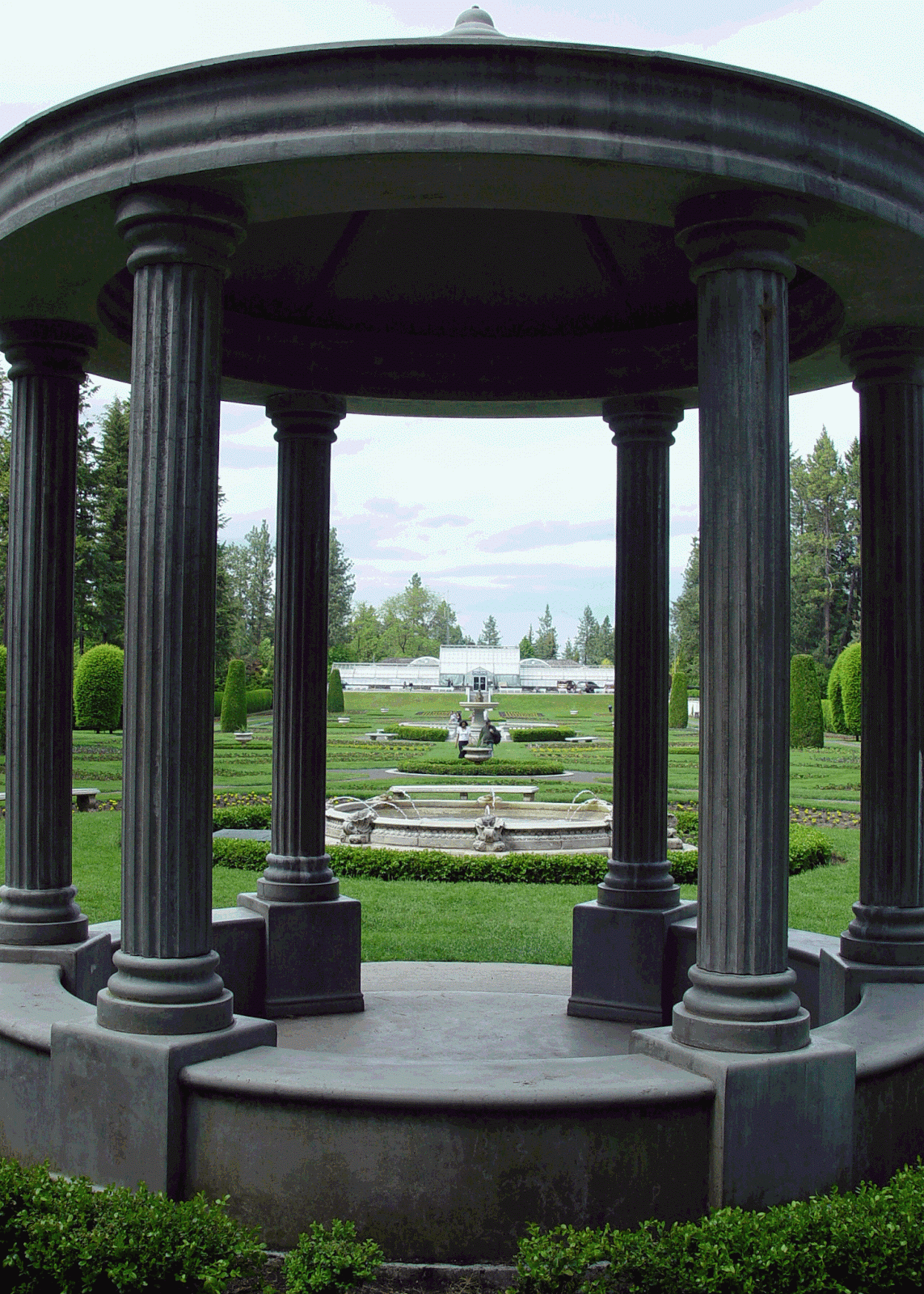
Looking south from the Conservatory to the gazebo. The sunken nature
of the  garden enables you to view the parterre pattern from above.

Duncan Garden is the Renaissance garden in Manito Park. The three-acre garden is laid out on a north-south axis, with the Conservatory at the northern end, the granite gazebo at the southern end, and the fountain at the smaller intersecting axis. A series of clipped Yews borders the garden, pulling the eye to the horizon line, and a tunnel of trees provide an allée on the intersecting axis. The flowerbeds are arranged in parterres, forming a tapestry of color. When we visited in May, the flower beds had just been planted so they were just getting started, but during the growing season the beds are full of color. Walking paths are wide, enabling unhurried ambles through the garden.

Granite fountain at the intersection of the two axes
Duncan Garden was originally named the Sunken Garden, because its loamy soil had been excavated for use in other park gardens around the city. In 1912, John Duncan envisioned a Renaissance style garden in the location, and in 1941 the garden was renamed to Duncan Gardens in his honor. The granite fountain was a private gift given in honor of Louis Davenport in 1956, and the gazebo was a commemorative gift from Friends of Manito to mark the park’s 100th anniversary. This is a lovely garden to visit, and highlights the powerful influence of Renaissance garden design principles.
Looking north from the gazebo to the Conservatory.
 

Wednesday, February 22, 2012

Eden by the Bay – First Anniversary

Yesterday the Eden by the Bay blog celebrated its first anniversary! That means 154 posts covering everything from Mediterranean climates, desert plants, arborists, pruning, and vegetable gardening to Sunset climate zones, roof top gardening, great gardening books, holidays, movies with plant movie stars, and gardening history. For the most part, I’ve stuck with the original charter of gardening in the San Francisco Bay Area. But, I soon found that there is a connection between the larger botanical and gardening world, and the specific world of gardening in the San Francisco Bay Area.

Welcome to Eden: The first post!

I’ve learned a lot about blogging in the last year, and had fun trying out the Google Blogspot tools. I’ve especially enjoyed interactions with the Eden by the Bay community. We have readers from all over the world, including Russia, British Isles, Canada, India, Pacific Rim, Europe, Eastern Europe, Australia, Africa, and the Middle East, to name a few, in addition to the Americas. I love having gardening friends all over the world! I also love getting links to interesting articles from readers, and try to share them. Keep them coming!

It has been a great year. I plan to keep going and hope you’ll continue joining me on the wonderful journey of gardening, whether in the San Francisco Bay Area, or in the wide world of gardening!

Friday, May 6, 2011

Japanese Gardening

I would love to know more about the Japanese gardening style. I think I “know it when I see it”, but I really don’t know all that much. When I think of a Japanese garden I think of a serene place that is very naturalistic - nature is tamed to present the best of itself. A Japanese garden is comprised of plants, and structures, such as small buildings, lanterns, paths, bridges, and ponds. Ideas may be represented in the Japanese garden, for example, water may be represented by gravel or sand, and plants may represent life.

When I think of a palate of Japanese plants, I think of iris, camellia, rhododendron, azalea, pine, and maple. I also think of a very distinctive pruning style, which showcases the trunks, branches, and leaves of each tree. The aesthetic pruning class series that I have been taking at Merritt College is heavily influenced by Japanese gardening.
Pine tree
My garden benefits from the pruning skills of Yakito who is a pruning artist in the Japanese style. His artistry has found its way to many of the trees in my garden.
Maple tree

Wednesday, May 4, 2011

Kimura Style Gardening

Kimio Kimura designed the Japanese Gardens of the Hayward Area Recreation and Park District over a period of 30 years, and continues to tend the garden. Kimura was born in Japan, and migrated to the United States to attend University. At the prompting of his father, Kimura studied economic and international business for his undergrad degree; Kimura switched to Landscape Architecture for his Masters Degree at University of California, Berkeley.


Kimura uses physical objects to demonstrate dynamic
groupings of rocks and plants.

On the first Saturday of the month, Kimura gives an informal lecture about his Japanese gardening ideas, which he calls Kimura style. The basic garden elements are water, stone and plants. He demonstrates how to achieve dynamic balance by grouping two or three components in different combinations – varying texture, placement, and height. He also describes the importance of each gardening element as an individual, and its contribution to the overall garden.


Here Kimura uses objects to help students
visualize the distinctive layered look
of a pruned tree.

I learned a lot from Kimio Kimura, and plan to return to learn more. It is inspiring to learn from a master, and Kimura encourages students to ask questions. He is writing a multi-volume book that describes and illustrates his design principles.


Sunday, May 1, 2011

Hayward Japanese Garden

I recently visited the Japanese Gardens of the Hayward Area Recreation and Park District. The garden was designed by Kimio Kimura, of Kimurascaping, using the principles of traditional Japanese garden design. For an informative description of the garden and its interesting history see the Wiki page. The garden is peaceful and beautiful, a wonderful place for meditation or contemplation.


Path through the garden.

My focus was on pruning, so I was especially interested in the trees and shrubs, and the feel of the garden. I could see many of the principles I’ve been learning in the Aesthetic Pruning series taught at Merritt College, including unveiling the best of a tree or shrub, showing particular traits in bark, leaves or needles, stems, and so forth.


Beautiful trunks revealed.
Gracefully flowing needles.

The garden follows traditional garden design, but uses the plants, rocks, and materials of the local environment. This is a great model for developing a garden in the San Francisco Bay Area. You can emulate or follow a favorite gardening design, but incorporate native plants and materials that will thrive in the local environment.


Holly bush incorporated into the garden design.

This is a garden to visit again and again, for personal reflection and respite from the cares of the day, and to view the seasonal changes unfold.

Saturday, March 12, 2011

Finding the Essence of a Tree

I recently attended a pruning class called Finding the Essence of a Tree, taught by Michael Alliger. The class is part of the Aesthetic Pruning series that is held on the Merritt College campus. Aesthetic pruning has two goals:
  • Enhance the natural form of the tree.
  • Enhance the function of the tree in the garden design.
According to Alliger, pruning is more than removing what is bad; it is also about revealing what is good. This includes revealing the tree as a representative of its genera, species, or cultivar, and revealing its individual characteristics. The goal is to make each aspect of the tree or bush readable. Readable elements include the root crown, trunk, branches, foliage, and the flowers and fruit. Alliger advocates studying trees in books and in their natural setting, to see how they grow without interference; and to study Bonsai forms, which emulate the natural form of a tree in miniature. Then prune to liberate the tree's essence.
A Madrone in nature, with its beautiful
bark, leaves, and distinctive berries.

To find out about the series of classes see: http://www.aestheticpruning.org/AP/Classes.aspx. The series lasts for a year, but you can attend classes in any order, over a period of several years.

Saturday, March 5, 2011

The Art of Structural Pruning

I have been attending a series of aesthetic pruning classes, held on the Merritt College campus in Oakland. Aesthetic pruning refers to the art and science of pruning small trees and shrubs in the garden, using design principles that honor the essence of the plant. The first aesthetic pruning class was developed in 1986 by Dennis Makishima, from the Merritt College Landscape Horticulture Department. Michael Alliger and others developed additional classes to form the series. Alliger teaches many of the classes, and has a wonderful way of conveying principles, demonstrating artful cuts, and providing practical information.
Through this series, I have learned that many of the pruning rules you read in gardening books do not apply in the San Francisco Bay Area. For example, in many instances, you can prune year round. You just need to understand a tree or shrub’s growth pattern, and what you are trying to achieve with your pruning.
In The Art of Pruning Deciduous Trees and Shrubs, I learned the concept of structural pruning for deciduous (leaf dropping) trees. In the winter, without the leaves, you can see the base structure of a tree. This enables you to make structural cuts that enhance the tree’s form for its winter silhouette, and its long term development. There is beauty in bare tree limbs against the winter sky.
The Bay Area has many gardening resources; the Aesthetic Pruning Series is one of its treasures. To learn more about aesthetic pruning, visit http://www.aestheticpruning.org/AP/Default.aspx. To find out about the classes, visit: http://www.aestheticpruning.org/AP/Classes.aspx. The series lasts for a year; you can attend classes in any order, over a period of several years.
Without leaves, a tree's basic form is revealed.