Home Page

Showing posts with label flower beds. Show all posts

Sunday, August 26, 2018

Rambles in Drizzly Juneau

Travel pulls you away from familiar routines and faces, and thrusts you into new situations and possibilities. Recently my husband and I were transported out of hot, dry, smoky San Francisco Bay Area and inserted into cool, damp, misty Juneau, Alaska. The purpose was the unbirthday of a certain nonagenarian who didn't want a lot of fuss. In loving response, family from all over the West coast descended on Juneau for an uncelebration (my aunt from the Bay Area, my sister and family from Bend and Portland, and my brother and family from Juneau and Portland).

Family home under threatening skies
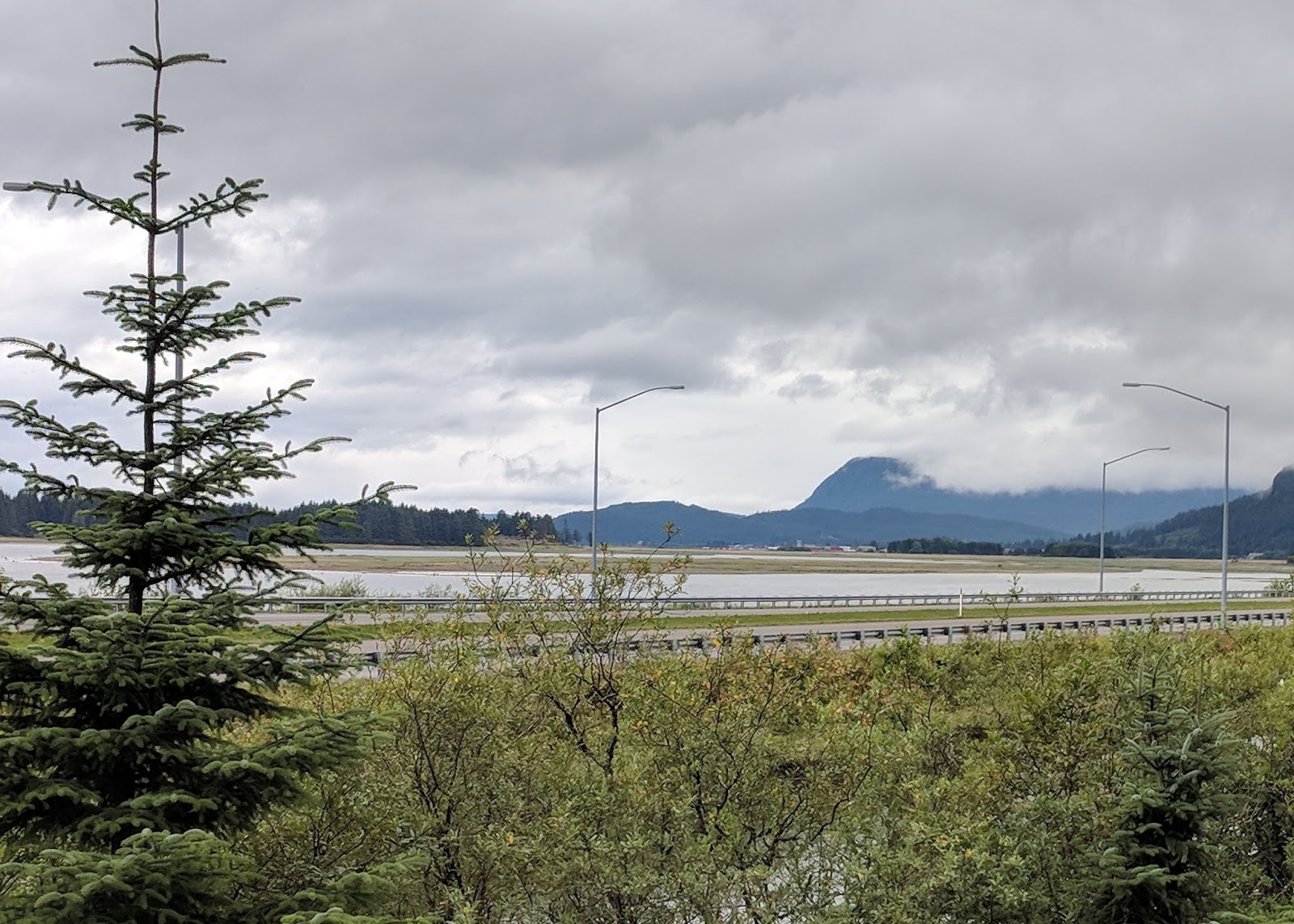
Overcast sky looking down channel toward the airport
Lovely flower bed against a spruce hedge

Locals never let a little rain keep them indoors, and neither did we. The rain is more of a drizzle, and rarely a downpour in Juneau (especially in the summer), so a light, waterproof jacket with a hood or a hat, and sturdy shoes is typically all you need. Weather is as changeable in Juneau, as it is in San Francisco and Seattle (as they say, "if you don't like the weather, wait five minutes").

Tahku by Skip Wallen

We wanted to see the Skip Wallen whale sculpture fully installed (recall last year we had seen it during its installation – see Beautiful Juneau). It is located in the Mayor Bill Overstreet Park near the bridge that connects Juneau with Douglas Island. The new sculpture is fantastic - with water works that cycle every five minutes or so, making the whale seem to be breaching with water streaming down its body. The installation provides a special vantage point of the surrounding mountains and town, and the boardwalk provides an easy route from the cruise ships docked downtown (no doubt providing a welcome walk for the younger cruise ship set).

The boardwalk with a view to cruise ships docked in downtown Juneau

Several ships in port

Watching cruise ships dock in downtown Juneau is serious sport. Typically three or four cruise ships are in port every day, causing the population to swell by up to 10,000 people! One five-ship day, a group of us headed down town to watch the spectacle. With GPS and modern equipment, docking these huge ships is precision art and science, and amazing to see. We watched as one ship departed, and another one moved in seamlessly to take its place in a matter of minutes.

Watching the cruise ships in port

Cruise ships, fishing boats, and pleasure crafts

Enjoying the sights


For a quick respite from the drizzle, my husband and spent a few hours in the new Alaska State Museum. We enjoyed seeing the "Grand Visions of The Great Land" and "Titanic of the north: The 1918 Wreck of the S.S. Princess Sophia" exhibits, and other permanent collections detailing the settlement and history of Alaska (from the Russians, to Captain James Cook, to mining, drilling, logging, and fishing). I'm always especially drawn to the First Peoples exhibits.
My Example

Petroglyph from Wrangell, Alaska

Ancient wooden mask

Chilkat robe from Sitka

Mountain goat yarn for weaving

My sister and I drove by this beautiful garden, the creation of our sister-in-law, who is an amazing gardener. Every summer she fills planters and containers with beautiful flowers for the short, intense growing season. Tourists and locals alike slow to take in the beauty as they pass by. Her work is also on display in the landscaping around Foodland.

Charming container garden

At the end of any good ramble in the rain, a delicious meal and great conversation makes it all the better.

My Example


 .


Wednesday, June 20, 2018

Kolb House at Heritage Park

While at Dublin Heritage Park and Museums, be sure to take the tour of Kolb House. The Craftsman style bungalow was built across the freeway for George Kolb in 1911, and later moved to Heritage Park to start its new role as a museum.

Kolb House from the front entrance

The Kolbs migrated from MΓΌnsterappel Germany in 1880, spent a few years in Philadelphia, and ended up in Pleasanton, California in 1884. George Kolb purchased the Dublin general store, married Wilhelmina Hartung, and together started their family. Kolb purchased 200 acres of land, built the house in 1911, and the family moved in.


Calla lilies edge the front of the house
Back entry, with the Challenge Dairy headquarters across the street

The craftsman style bungalow worked well as a farmhouse, with its wide overhanging eaves to protect from the hot sun, and wrap-around porches for gathering, extra workspace, or catching a breeze. A kitchen garden outside provided vegetables (with a lot of effort to keep the deer, moles, and birds away).

Raised bed kitchen garden, now planted by visiting school children
Kenmore washer in the laundry porch

I especially appreciated the laundry porch and adjoining kitchen. The Kenmore roller washing machine would have been a time saver (Mom used one of these in Hollis, Alaska, the logging camp where Dad spent several months of the year researching for the Forest Service early in his career). The cooler kept fruits and vegetables cool with air from under the house (Grandpa Bob built a cooler for Grandma Char in their Southern California bungalow).

The cooler

The house is furnished with the family's furniture and artifacts, giving it a feeling of authenticity. Many on the tour commented "my grandma had that" or "my great-aunt used one of those". For us, it was a journey down memory lane.

My Example
The range

Pastry station , with flour bin


For school age children, it would be a source of wonder - "how could they only have one bathroom, and why was by the back door?" and "how can they charge the computer without any wall plugs?". No matter what your age, you're sure to enjoy a tour of Kolb House.

Original location of the Kolb House, across the orchard from "downtown Dublin"


Wednesday, June 6, 2018

Dublin Heritage Park and Museums

Dublin Heritage Park and Museums is a ten-acre park located in the crook of the Interstate 580 freeway as it swings around from the valley floor to make the grade through the pass heading west toward the East Bay. It is a gem of a place to spend an hour or two if you're in Dublin, California, and want to be transported back in time a hundred years or so. The location was  the original "downtown Dublin" for the surrounding homesteads. As Dublin transformed from farmland to a modern town, a few forward-looking folks sought to preserve a little of its dairy farming history.
Dublin Heritage Park and Museums

The old St. Raymond Church (built in 1859) and the Dublin Pioneer Cemetery (established in 1859) are in their original locations. The Murray Schoolhouse, Kolb House, and associated barns were moved from across the freeway as the original farms were carved up for development projects. A small stream and forest insulates Heritage Park from the freeway, and the grounds are landscaped with plants you might see in the early 1900s, like hollyhocks and rambling roses. Across the street is the Challenge Dairy headquarters, and the original Green general store building.

The schoolhouse has wonderful exhibits for kids (and grownups) showing what it was like to attend school in a one-room schoolhouse, and to live and work on a dairy farm. The headstones in the cemetery provide a glimpse into pioneer life, and the church is a testament to early settlers who pitched in to build the center of spiritual and community life. I especially enjoyed our personal tour of the Kolb House, built in the Craftsman Bungalow style that was becoming popular at the turn of the twentieth century. I recommend visiting the Dublin Heritage Park and Museums, and checking out the photographs at the Online California Archive, the Dublin Heritage Museum collection.

Wednesday, October 29, 2014

Hildene House Hardscaping

A garden is always more than its plants and flowers. Hardscaping provides the structure and bones of the garden or landscaping. Hildene House had a great collection of hardscaping for the property and the garden. Here are some of my favorites.

Grand Entrance

An estate really should have a grand entrance, and this sweeping driveway and covered entry is a perfect. What could be more civilized than to arrive and alight from horse and buggy or car, protected from the elements?

The grand entrance at Hildene House

Observatory

Every estate should have one. Robert Todd Lincoln was an astronomy buff, and built this mini observatory for star gazing. It is still used today.

A private observatory

Fences and Walls

The house is built on a promontory overlooking the valley below. Fences and walls are nicely used to protect visitors from taking a tumble.


Wrought iron fence implanted in the cliff
Stone wall provides a protective barrier to the cliff below

Paths

Paths guide visitors, and provide protection for the land. I liked the variations of brick paths used on the estate. I was also intrigued with the use of marble.

Marble and brick path
 
Rustic brick path
 

Green House

The green house would have been interesting while in use, but it is also interesting as a relic. It looks like some of its former plantings are now taking over.

Weathered frame of a relic greenhouse

Flower Beds

The formal flower beds are contained with clipped hedges, the cutting garden with a weather wooden fence.

Clipped hedges provide the frame for formal flower beds
Marble and clipped hedges
Weathered wood fence of the cutting garden

Arches and Pergolas

The arch leading to the kitchen and cutting garden, and the pergola of the formal garden provide an invitation to roam, and framing for the views.

Arch with seating beckons the visitor to the cutting garden

Pergola provides some shade, and a frame for the landscape
 

Sunday, October 26, 2014

Hildene House

Hildene House is located near Manchester, Vermont, in the southwestern corner of the state, and was the summer home of Robert Todd Lincoln and his wife Mary Eunice (Harlan). Robert Lincoln was the only surviving son of President Abraham Lincoln and Mary Todd Lincoln. We visited on a moody, cloudy day that threatened rain.

Sweeping grounds of the Hildene estate
Hildene is a composite of old English words meaning hill and valley with stream, which is a perfect name. The 412 acre estate encompasses a hill overlooking a valley, meadows, and wetlands. The summer estate is now run by the Friends of Hildene. They give tours of the estate, which includes a working farm, a Pullman train car, and the house and garden.

Working farm on the Hildene estate
Lincoln (1843 – 1926) was a lawyer like his father. He was educated at Harvard University and the Old University of Chicago law school, and was admitted to the bar in 1867. He served as Secretary of War (1881 – 1885), and as United States minister to the United Kingdom (1889 – 1893). Later he worked as general counsel of the Pullman Palace Car Company, and then became its president in 1897 after George Pullman died.

Pullman Car - Lincoln was president of the Pullman Palace Car Company in later years
The house is built in the Georgian Revival style, and built on an outcrop overlooking the Battenkill Valley. A sweeping driveway delivers the visitor to the front entry. An antique red car stands at the ready. The front lawn has markings representing the size of the log cabin in which Abraham Lincoln was raised in contrast with the size of his son’s summer estate.


Front entrance of Hildene House - the sign describes the lawn markings outlining the size of Abraham Lincoln's family cabin
We toured the house interior, which is furnished with Lincoln family furniture and possessions. I was impressed with how cozy and comfortable it was. I can see why it would be a destination in the heat of summer.

Hildene House formal garden
Hoyt Formal Garden
Behind the house is the Hoyt Formal Garden. The formal beds are designed to resemble a stained glass window – with clipped hedges demarking the beds of annuals and perennials. From the house and charming garden is a beautiful view of the valley and hills beyond.  Our docent explained that in Lincoln's day, the hills would have been farmland. Over the years, they have reverted to native forest land.

Borrowed view of the valley and hills

Sunday, October 12, 2014

Boston Public Garden

The Boston Public Garden was established in 1837 to be the first public botanical garden in the United States. It is a small, rectangular parcel, bound by Beacon, Arlington, Boylston, and Charles Streets, and is comprised of 24 acres on the site of an old salt marsh.  You can see Boston Common right across Charles Street. Both Boston Public Garden and Boston Common were part of the Emerald Green Necklace of contiguous parks envisioned by Frederick Law Olmsted, but never fully realized. (We have encountered Olmsted before, as the designer of Mountain View Cemetery in Oakland, and of Central Park in New York City).

Graceful willows along the bank of the lake

Central to the design is a serpentine lake, intersected by a unique suspension bridge. Mature weeping willow trees grace the sides of the lake. I can see why folks from the East frequently plant willow trees in their yards when they move to the West. They are beautiful, and would be a wonderful reminder of home (though not a good water choice in our dry Western climate). A Victorian era wrought iron fence surrounds the park.
Gum drop trees and planting bed

The lines of Boston Public Garden are curving rather than linear, reflecting the move to a more naturalistic style of gardening that was emerging. We’ll learn more about the Landscape Movement in future Gardening History posts – the style was emerging in reaction to the extravagant, manicured gardens of the Renaissance; Revolution in Europe and America; and the demands of the Industrial Age. Paths meander through the park, enabling you to stroll at your own pace (compare with the practical linear paths of Boston Common, which get you efficiently across the green belt).


The garden uses bedding plants in the Victorian style – bright exotic flowers and plants in combination, and designed to be swapped out seasonally. Shaped shrubs are used, but not in the extravagant shapes or heights of the Renaissance. The park is home to a collection of native and exotic trees, including Ginkgo, Dawn redwood, elms and oaks, and many others, befitting the first American botanical garden and true to the Victorian zeal to collect plants and trees discovered all over the world.
Rose garden and fanciful clipped shrubs

My husband and I walked through Boston Public Garden on our way to see the beautiful and historic Trinity Church and Boston Public Library, and returned another day to stroll and explore the Garden. We had perfect fall weather – sunny, clear, and warm. The leaves were just starting to turn to their fall colors. This increased our optimism about finding fall colors on the next leg of our trip –  North to Vermont.

Fall colors and dappled shade