Home Page

Showing posts with label containers. Show all posts

Wednesday, December 1, 2021

Back to the Land: Wrap Up

This has been another wild year! Our "back to the land" theme, with its focus on our residential lot in the San Francisco Bay Area, was perfect for Year Two of the pandemic. Even with restrictions lifting a bit, thanks to vaccinations and good practices, it was good year to continue staying home. We used the time to explore what our property has to offer, looking at its role as a "homegrown national park", a source of materials for dye projects, and place to relax and enjoy nature.


Red camellia


Plant Aquarium

We learned more about some of the trees, shrubs, and plants that grow on our urban land. Some are native, some are not.

My Example

Polypodium
Juniper
Oak
Toyon
Pittosporum
Liquidambar
Hollyleaf Cherry
Chinese Elm
Hawthorn
Magnolia


Enjoying Nature

We enjoyed the seasons and the local birds and critters that visit our residential yard. The small plot is part of a larger virtual "wildlife corridor" that provides water, food, and shelter for urban wildlife and migrating birds.

My Example

Signs of Spring
Summer Time
Fall is in the Air
Winter is Coming
Red-Bellied Sapsucker
Enjoying Winter Moss
California Scrub Jay
Where are the Hummingbirds?


Garden Projects

We're working on garden infrastructure in preparation for future projects, and enjoying the yard just as it is.

My Example

Soil Restoration Under the Oak
Wood Chips Under the Oak
Oak Patrol
Symphony in the Garden
Raised Bed Prep for Fall Greens
Farewell to the Chinese Elm
Dyeing Fabric with Plants


Seeds to Dye For

This year I sowed seeds for several plants that are good for dyeing fabric - calendula, coreopsis, and marigold. I tried solar dyeing for the first time, using calendula flowers.

My Example

Seeds to Dye For
Seeds to Dye For: July Check In (Calendula)
Seeds to Dye For: September Check In (Coreopsis)
Seeds to Dye For: November Check In (Marigold)
Dye Project: Solar Dyeing with Calendula


Excursions

As the pandemic drags on, even an outing to the grocery store becomes an adventure! My husband and I made a few special excursions to remind us of normal life.

My Example

Van Gogh Immersive Experience
Judge John Sutter Regional Shore
Benicia and the Delta


Books and Movies

We traveled the United States and the world vicariously with famous British landscape gardener, Monty Don, to enjoy plant movie stars. We also learned more about the mighty oak tree and its lifecycle.

My Example

Winter movies:  Prairie Gardens  Southern Gardens  Western Gardens
Summer movies:  Southeast Asia  The Med  India
The Life of an Oak


Wednesday, November 10, 2021

Seeds to Dye For: November Check In

This is my final report on the seeds that I planted back in April, all of which produce flowers that are used to dye fabric. I sowed seeds in containers, and have reported on them over the last seven months (see Seeds to Dye For and related posts). So far I've used the calendula flowers for a dye project (see Solar Dyeing with Calendula), and have collected and dried the coreopsis flowers for a future dye project. This time I'm reporting on the marigolds (Tagetes signata).


Marigolds in November

It's November in the San Francisco Bay Area, and the marigolds are still going strong. In fact, they are flourishing after the the recent winter rains. The plants look a little disheveled, because the container is a favorite place for squirrels to stash acorns throughout September and October.


Planting seeds in late April

Putting on growth in early August (pottery boot by Jason Quisenberry)

According to Botanical Colors, marigold flowers produce a wide range of colors in the yellow, brown, and tan range. The variations depend on the mordants used, and the number of times the fabric is dipped. Marigolds can also be used as an overdye with indigo to produce various shades of teal and blue.


Good growth and flower buds in September

Closer look at the marigold flower buds

I've been collecting the flowers and drying them over the last month. As with the coreopsis, the flowers are quite small, and I'm not sure how much color they will yield. Next time I'll try planting Tagetes erecta, which has larger flowers. They were not available from Renee's Garden back in April due to supply chain problems, but I'm looking forward to trying both and comparing!


First flowers in mid-September


Wednesday, September 15, 2021

Seeds to Dye For: September Check In

Back in April, I sowed seeds for a few dye plants in containers (see Seeds to Dye For). The calendula seeds (Calendula officinalis) have already run their course. I've collected and dried blossoms for a dye project, and am drying a few seeds for the birds and for planting. Now the coreopsis seeds (Coreopsis x hybrida) are coming into their own. Their yellow and red faces are quite cheerful, and provide great transition color as fall approaches.


Coreopsis x hybrida

According to Botanical Colors, coreopsis flowers produce a bronzy-orange dye, and a more reddish shade with a pinch of soda ash added to the bath. Sounds lovely, but so far I'm not sure the flower yield will be enough for much of a dye project. I'll still collect and dry the flowers as they pass their prime, and see what happens!

Tall, lanky coreopsis

Heliotropic faces following the sun

My plants are quite tall and lanky, with a feathery, tiered leaf pattern that is quite lovely. They must be heliotropic, as their flower heads all face in one direction. I haven't seen any butterflies so far, but many insects pause on their flowers, including a tiny lady bug that was about the same size as the flower bud.


Ladybug rests on the bud (a little blurry, but so cute I couldn't resist)


Wednesday, July 28, 2021

Seeds to Dye For: July Check In

 Three months a ago I sowed the seeds for a few dye plants in our Oakland garden (see Seeds to Dye For). So far the calendula seeds (Calendula officinalis) are showing the most promise. Our weather here in the San Francisco Bay Area has been ideal for them, since they bloom best in cool weather, and our temperature has been in the low to mid-70s all summer.

Calendula officinalis

I planted Orange & Lemon Twist (Butterfly Calendula Mix) and Flashback Calendula (Butterfly Mix), and the flowers are cheery shades of yellow and orange. According to Mother Earth News, calendula flowers produce light, lemon yellows, olive-browns, and light browns, depending on the fabric and mordant used.

Orange & Lemon Twist (left container) and Flashback Calendula (right container)

The plants are really packed in their containers, since I failed to thin the seedlings as recommended. They get a good supply of water applied to the soil, and not splashed on the  leaves, to reduce the chance of mildew. The lower leaves are showing signs of yellowing and wilt so I may be overwatering them (I am notorious for killing plants with kindness).


Yellow calendula

Following recommendations on the web, I've started gathering flowers, just as they pass their prime. Most information say to dry the flowers, but my method of freezing flowers has worked on other projects. With a second sowing possible in late summer, I should be able to gather enough petals with which to experiment! Stay tuned!

Orange calendula


Wednesday, April 21, 2021

Seeds to Dye For

This year we're focusing on our little plot of land here in the Oakland hills, located in the San Francisco Bay Area. I plan to dye fabric using plants that are already growing on the property (and am anticipating many shades of brown)! To mix things up, I've ordered seeds from Renee's Garden for annuals that are known to be good for dyeing, including marigold (Tagetes spp.), calendula (Calendula spp.), and coreopsis (Coreopsis spp).


Planning

So far I've planted the calendula seeds (Calendula officinalis) since they bloom best in cool weather. The flowers are typically shades of yellow and orange. I ordered Orange & Lemon Twist and Flashback Calendula. According to Mother Earth News, calendula flowers produce light, lemon yellows, olive-browns, and light browns (depending on the fabric and mordant used). 


Calendula seeds sown in early April

The seeds sprouted within a week (along with quite a few tiny mushrooms). The sprouts range from 2 to 3 inches tall and are quite gangly. I'm notorious for killing sprouts with kindness by overwatering, so am attempting to restrain myself. 

Orange & Lemon Twist on the left, Flashback Calendula on the right

Stay tuned - we'll see how it goes!

Wednesday, September 2, 2020

Amaryllis Care

It's no secret that I love Amaryllis blossoms (Hippeastrum spp.) If in doubt, see Forcing Bulbs: AmaryllisFavorite Christmas Plants, and Forcing Amaryllis Bulbs. Once they bloom, I let the bulbs go dormant, and then replant them in large communal pots. With some care, the bulbs flower in subsequent years, although the blooms are typically smaller and not as bodacious as the initial bloom. It is still satisfying.

Amaryllis bulbs of various ages (mature and pups)

I noticed that my pots of Amaryllis were starting to look a little bedraggled, and a few plants were dusted with white powder, indicating some kind of pest. Time for some clean up and TLC!

Soaking the roots in a little water

I dug up the bulbs and inspected the roots. They looked long, strong, and healthy, despite what was happening above ground. I trimmed the shoots, cut the roots back to about 4 inches long, and then let the roots soak in a pail of clean water to mitigate the shock. This gave me time to scrub the pots inside and out.

Fresh soil in the clean pots

Next, I replanted the bulbs in fresh potting soil, being careful not to damage the roots, and then topped-dressed with fresh moss. Finally, I watered them in carefully, to make sure the bulbs did not get flooded with water. After several weeks, the bulbs have started putting out leaves.

Freshly planted and top-dressed with moss

We'll see if the special care encourages another round of blossoms. In the meantime, I'm content to watch the fresh foliage grow.

Wednesday, August 5, 2020

Easter Lily Care

Last year a friend gave us a beautiful Easter lily in a container. We enjoyed its blossoms and variegated leaves for several months, and then the plant died back to replenish itself. The bulb was completely neglected over the winter. In late spring, I noticed a few fresh sprouts, and decided to give the lily some care.

Multiple new sprouts from the same bulb

I replanted the bulb in a terracotta pot with fresh potting soil. The original plastic pot  was getting too small and looking a little battered. Within a few weeks, the sprouts really took off, and the leaves started to unfurl.

Stems and leaves emerge
(Snake Pot to the left by Jason Quisenberry)

Now we're enjoying the beautiful leaves and how they soak up the sunlight. The plant is doing very well on the patio (although some kind of insect has munched on a few of the tender leaves as they emerge). We're still waiting for blossoms, but enjoying the plant as it is. New life!

Flourishing, but no sign of flowers

Wednesday, August 21, 2019

Summer Containers

Container gardens thrive this time of year in the San Francisco Bay Area. It's hard to beat a container or group of containers of bright summer annuals in the dead heat of summer. With daily watering, a little deadheading, and fertilizing periodically, you can keep your containers fresh and blooming for weeks!

Containers in the early morning

I planted these petunias a month ago in preparation for my sister's visit to the Bay Area (see Two Sisters, 48 Hours). Supporting the white and pink petunias are purple salvias, white alyssum, and an unnamed purple "Annual" (the milky fluid it produces when deadheaded reminds me of milkweed).

Petunias, salvia and alyssum

The variety of pots provides extra interest, including several lovely terracotta pots with white patina, a blue glazed ceramic pot, and a deep green plastic pot.

The simplicity of white flowers in a terracotta pot

I enjoy the morning ritual of watering, deadheading, and looking for tiny green petunia budworms that love to eat their way through the petals. Nature!

Sunday, August 26, 2018

Rambles in Drizzly Juneau

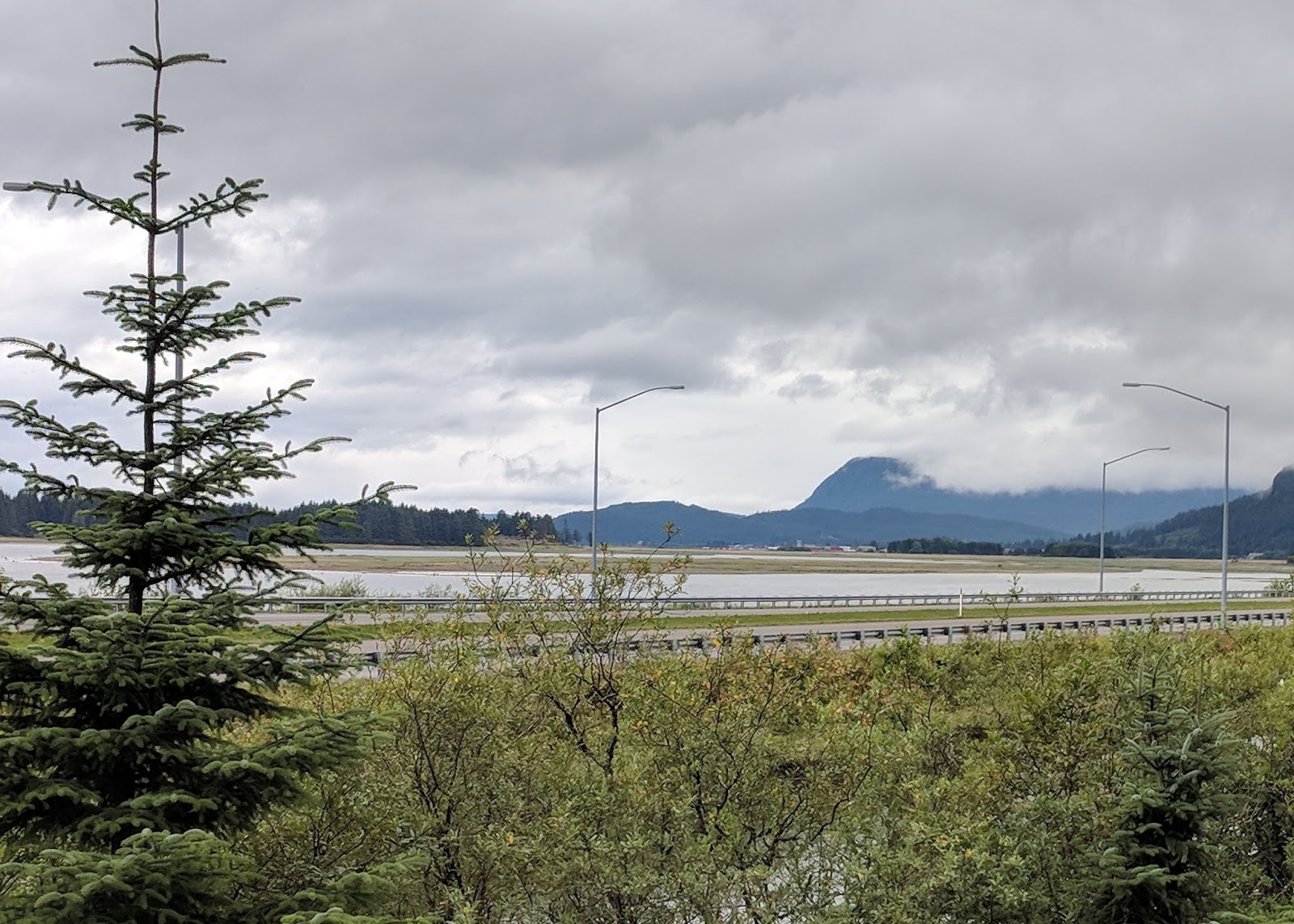
Travel pulls you away from familiar routines and faces, and thrusts you into new situations and possibilities. Recently my husband and I were transported out of hot, dry, smoky San Francisco Bay Area and inserted into cool, damp, misty Juneau, Alaska. The purpose was the unbirthday of a certain nonagenarian who didn't want a lot of fuss. In loving response, family from all over the West coast descended on Juneau for an uncelebration (my aunt from the Bay Area, my sister and family from Bend and Portland, and my brother and family from Juneau and Portland).

Family home under threatening skies
Overcast sky looking down channel toward the airport
Lovely flower bed against a spruce hedge

Locals never let a little rain keep them indoors, and neither did we. The rain is more of a drizzle, and rarely a downpour in Juneau (especially in the summer), so a light, waterproof jacket with a hood or a hat, and sturdy shoes is typically all you need. Weather is as changeable in Juneau, as it is in San Francisco and Seattle (as they say, "if you don't like the weather, wait five minutes").

Tahku by Skip Wallen

We wanted to see the Skip Wallen whale sculpture fully installed (recall last year we had seen it during its installation – see Beautiful Juneau). It is located in the Mayor Bill Overstreet Park near the bridge that connects Juneau with Douglas Island. The new sculpture is fantastic - with water works that cycle every five minutes or so, making the whale seem to be breaching with water streaming down its body. The installation provides a special vantage point of the surrounding mountains and town, and the boardwalk provides an easy route from the cruise ships docked downtown (no doubt providing a welcome walk for the younger cruise ship set).

The boardwalk with a view to cruise ships docked in downtown Juneau

Several ships in port

Watching cruise ships dock in downtown Juneau is serious sport. Typically three or four cruise ships are in port every day, causing the population to swell by up to 10,000 people! One five-ship day, a group of us headed down town to watch the spectacle. With GPS and modern equipment, docking these huge ships is precision art and science, and amazing to see. We watched as one ship departed, and another one moved in seamlessly to take its place in a matter of minutes.

Watching the cruise ships in port

Cruise ships, fishing boats, and pleasure crafts

Enjoying the sights


For a quick respite from the drizzle, my husband and spent a few hours in the new Alaska State Museum. We enjoyed seeing the "Grand Visions of The Great Land" and "Titanic of the north: The 1918 Wreck of the S.S. Princess Sophia" exhibits, and other permanent collections detailing the settlement and history of Alaska (from the Russians, to Captain James Cook, to mining, drilling, logging, and fishing). I'm always especially drawn to the First Peoples exhibits.
My Example

Petroglyph from Wrangell, Alaska

Ancient wooden mask

Chilkat robe from Sitka

Mountain goat yarn for weaving

My sister and I drove by this beautiful garden, the creation of our sister-in-law, who is an amazing gardener. Every summer she fills planters and containers with beautiful flowers for the short, intense growing season. Tourists and locals alike slow to take in the beauty as they pass by. Her work is also on display in the landscaping around Foodland.

Charming container garden

At the end of any good ramble in the rain, a delicious meal and great conversation makes it all the better.

My Example


 .


Wednesday, January 24, 2018

Tennis Shoe Planter


I’m always on the hunt for fun ideas in the garden. While travelling in Seattle for the Christmas break, I came upon this tennis shoe planter. I loved the use of a found object to act as a container for a couple of succulents.
Container for succulents in the Pacific Northwest


I also love how the moss thrives in the damp conditions of the Pacific Northwest. Have you seen an innovative planter recently?

Sunday, September 24, 2017

Container Gardens of the North


Did you notice that almost every picture from our trip to Alaska and Canada includes dark skies, clouds, misty fog, rain, or some combination of the same? The sun punched its way through from time to time, casting brilliant light all around, but the overarching weather was drizzly rain.
Traffic circle in downtown Juneau, Alaska
Pansies and asters in the Haines Junction picnic area

Enter container gardens of the north! We saw them everywhere - containers of all shapes and sizes filled with bright cheerful annuals. Here are a few examples that you might enjoy.

Giorgio's in Whitehorse, Yukon

Alpine Bakery in Whitehorse


Raised bed in Haines Junction


Hanging baskets at the Raven

Innovative container

Pocket garden with dahlias

Welcome to Kluane Inn


The containers come in all shapes and sizes, and serve as raised beds, ensuring drainage to protect the roots, and air flow to reduce mold. The combinations of colors, shapes, and textures are so creative! Seeing these miniature gardens brightens the day for anyone slogging through the rain, or viewing dramatic scenery shrouded in mist.

Rain barrel container in Juneau

Rain barrel in Haines


Closely related is the pocket garden - a small space where someone has planted a tiny garden. We saw a few of them as well.


Pocket garden in Juneau

Another pocket garden in Juneau

The garden season is short and intense in the north, so gardeners must make the most of it. Planting cheerful containers or pocket gardens of bright flowers is a great solution!


Bottom of the porch pocket garden

Container of pinks in Juneau