Home Page

Showing posts with label plant communities. Show all posts

Wednesday, July 8, 2020

Native Plant Finder

In his Bring Back the Natives keynote, Dr. Douglas Tallamy spoke on what we can do to attract and sustain nature in our yards. Dr. Tallamy mentioned two tools for figuring out what to plant – Calscape and Native Plant Finder. Last month we took a look at the Calscape tool. This month we'll take a look at Native Plant Finder tool.

The Native Plant Finder website (in Beta) is designed to help you find the best plant species to attract butterflies, birds, and wildlife in your area. The data is sourced from the U. S. Forest Service, The National Wildlife Federation, and the University of Delaware, where Dr. Tallamy is a professor of entomology and wildlife ecology. Enter your zip code, and search for plants or butterflies that are native to your area.   

Native Plant Finder in a browser – enter a zip code to get started

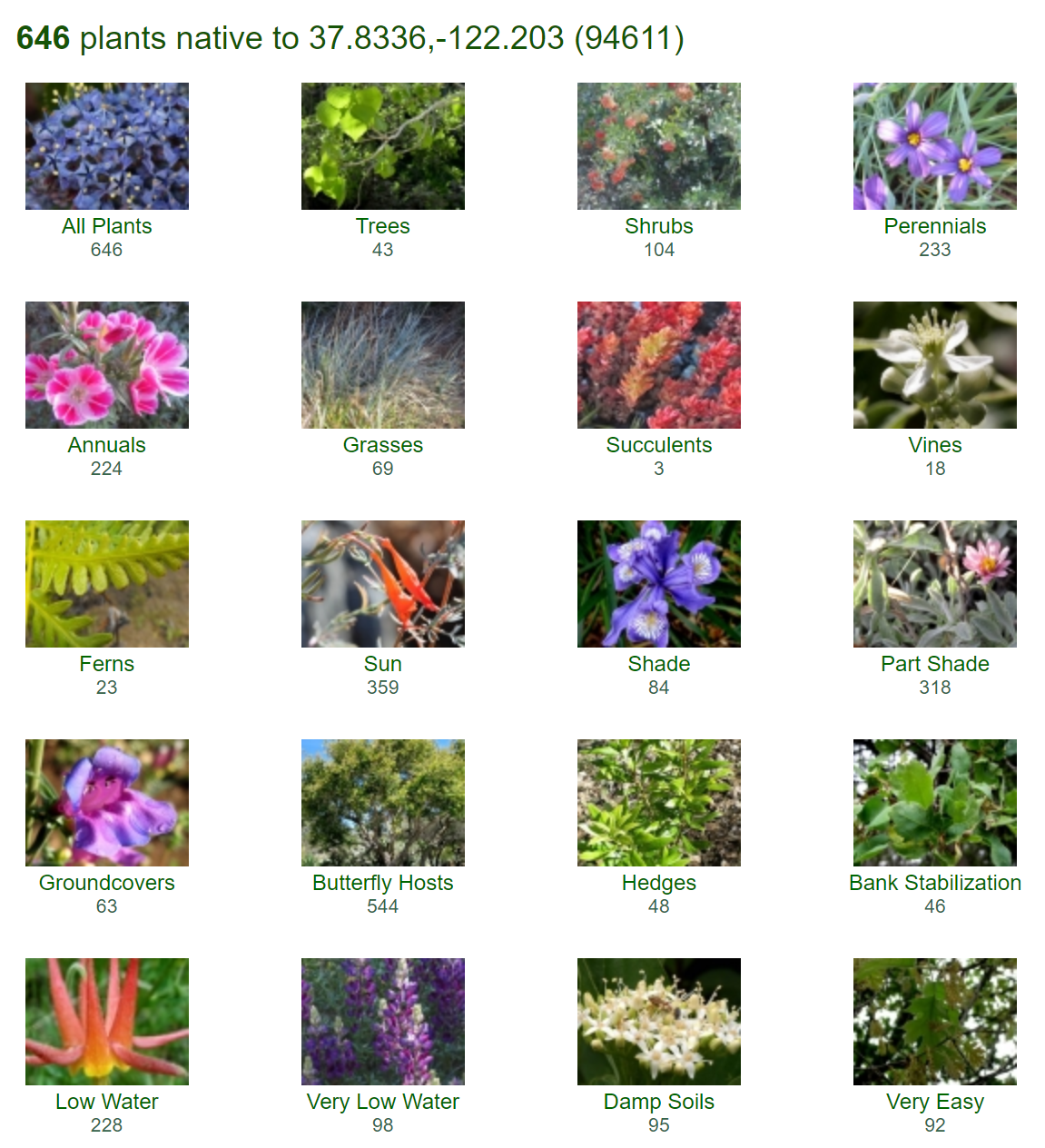
Native plants filtered by category for the zip code entered

For example, I can check the Trees and Shrubs section for hawthorns, to learn more about the hedge of hawthorn bushes in our yard. I find out that the native species in our area is Cratageus suksdorfii, and that 78 species of butterflies and moths use this bush as a caterpillar host plant. That probably explains the early morning chorus of birds in the lower yard!


The native hawthorn is a great caterpillar host plant

Save the plant and any of it attracted species to the list, for later research. 


My native plant and butterfly list
Select Suppliers > Native Plant Directory, to access a list of native plant suppliers by state. For California, I see several favorite nurseries here in the San Francisco Bay Area, including Bay Natives, Berkeley Horticultural Nursery, and The Watershed Nursery. If you use the mobile app, you have easy access to your lists and sources while out shopping for plants.

I highly recommend Native Plant Finder as a resource for anyone who gardens here in California, or in North America. You can use the tool without an account for general research or add a free account to use features like lists. I especially like the emphasis on hosts plants, no doubt thanks to Dr. Tallamy's entomological background. Not only can you learn which native plants would thrive in your garden, but which are the best host plants for attracting the birds, amphibians, and wildlife you'd like to see in your yard!

Wednesday, June 10, 2020

Calscape

In his Bring Back the Natives keynote, Dr. Douglas Tallamy spoke on what we can do to attract and sustain nature in our yards. He invited us to think of our yards as being part of the food web, and collectively as part of a wildlife corridor for migrating or nesting birds. By planting hosts for the kind of food that birds, insects, amphibians, and animals need, we help ensure their survival. For example, here in the Bay Area, the oak tree is a key host in the food web. Dr. Tallamy mentioned two tools for figuring out what to plant – Calscape and Native Plant Finder (in Beta).

Calscape is especially good for those of us in California, and the San Francisco Bay Area where we have so many microclimates. The data is sourced from familiar plant databases, such as Jepson, CalFlora, California Native Plant Society, Wikipedia, and many more. You can enter your zip code or address to filter data specifically for where you live, for example 94611.

Calscape in a browser – enter a zip code or address to get started

Native plants filtered by category for the zip code entered


We have a live oak in our yard (Quercus agrifolia), and I'd like to learn more about what it contributes to the food web. Select Trees > Coast Live Oak to dive in.

Native trees for the zip code

From there, I can learn all about the oak tree in my yard. Including all the butterflies and moths it hosts, which provide a generous food source for birds and other creatures.

Butterflies and moths hosted by the oak tree

Another great feature is that you can create plant lists as you research. I started an inventory of native plants that I find in my yard. I still have work to do.

Plant Inventory of our yard in Detail view

I also started a list of native plants to introduce into the garden, and downloaded it in spreadsheet format. I can also access the information through Calscape running in a browser on my mobile phone. Calscape also links to native plant nurseries in the area, making it easy to find out what plants are available and where.

Plant Wish List in Grid view

Spreadsheet version for easy access 

I highly recommend Calscape as a resource for those of us who garden here in the Bay Area, or anywhere in California. You can use it without an account for general research, but can add a free account to use some of the features like creating lists.

Sunday, January 4, 2015

Looking Ahead to 2015

Happy New Year! After a restorative holiday break, I’m ready to tackle another 365 days of work, life, and gardens! My focus is San Francisco Bay Area gardens, but it doesn’t take me long each year to branch into gardens and garden topics of the world!

Looking ahead, one of my big themes this year is “living with drought”. We are three years into a severe drought here in California, and plants are looking dry, dry, dry! Recent rains may help the situation, but I think that is part of the problem – we quickly forget once it starts raining. As more and more of us vie for this valuable commodity, we need to look for long-range, sustainable solutions for water management at the infrastructure and local levels. Even if it is raining today.

Bay Area botanical gardens
 
Drought in the central valley
 
Gardens in Alaska
 
California native plants
 

Other gardening goals for 2015:
  • Explore different types of botanical gardens available in the San Francisco Bay Area. They can provide valuable information about plants and trees.
  • Visit private and public gardens, and the big outdoors, to look for interesting landscape ideas. We’ll visit tame and wild gardens in Alaska, and plant communities in both the dry interior, and the moist panhandle.
  • Continue learning about drought-tolerant native plants, especially those that can replace our water-thirsty lawns and landscape plants. Also find out where to purchase them.
  • Continue exploring gardening history – this time back to England for the start of the Landscape Movement, fueled by English practicality and plant discoveries from the Americas.
Hope you’ll join me on this quest!
 

Wednesday, July 24, 2013

Sudden Oak Death

The plant pathogen Phytophthora ramorum, commonly called Sudden Oak Death (or SOD), is a water mold in the Oomycota class. I reported on Sudden Oak Death a couple of years ago as part of a series on oak trees. Most Phytophthora species are soil-dwelling, root pathogens, but P. ramorum is a leaf pathogen. Spores from the leaves and twigs of infected trees spread to an oak through water, wind-driven rain, plant material, or human activity. Once the spores are on the oak, microbes use natural openings to access bark tissues. The microbes kill cells, causing bark cankers, clogged water and transport systems, leaf die-off, and ultimately death of the tree. Take a look at SOD zoospores: http://youtu.be/rTo6UwnZiQg


Fascinating to me is that P. ramorum has a wide host range (including tanoaks, and non-oaks, such as California bay laurel, Rhododendron, and Camellia), but these hosts are not killed by the pathogen. Oaks, on the other hand, are considered terminal hosts; when they encounter the pathogen, they may become infected very quickly in the right conditions. According to the IPM, the best predictor of the disease is the presence of a California bay laurel.

Since there is no cure, prevention is the best way to manage Sudden Oak Death. Purchase non-infested nursery plants from a reputable dealer; remove infected oaks following local ordinances; remove non-oak hosts (such as California bay laurel); and dispose of infected plant debris properly (leave on the property as mulch or compost). The IPM website lists using phosphonate fungicide treatments (Agri-Fos) as a preventative measure. The treatment must be made on healthy trees, and repeated every year or two, so it is recommended for high-value trees.

Sunday, April 21, 2013

Presidio Coastal Scrub

A trail beckoned to us from the battery we were exploring in the Presidio; my folks, husband, and I answered the call. The trail followed the bluff, high above the rocky shoreline, giving us more grand views of the Golden Gate Bridge, ocean, and hills to the north. We were buffeted by the wind, blowing unabated across the ocean. I wished we had brought our walking sticks to help ground us!

Coastal scrub and Golden Gate Bridge (did I mention windy?)

In this area, a coastal dune scrub plant community replaced the coastal dune community of Baker Beach. Low lying grasses and bushes grew along the bluffs, holding them in place, along with a few gnarly trees. You can learn more about the coastal dune scrub plant community on the National Park Website: http://www.nps.gov/prsf/naturescience/coastal-dune-scrub-community.htm

Beckoning trail high on the bluffs


Wild coastal vistas, just a few miles from downtown San Francisco

Many of the flowering plants are small and low to the ground, similar in size to the miniature plants we see growing in the harsh conditions of the tundra in Alaska and Canada. Some of the plants that grow in the Presidio area are common natives and non-natives, others are rare or endangered.


After a day of exploring the wild side of the Presidio, we headed back to the East Bay for dinner at one of our local neighborhood Chinese restaurants and good conversation. I recommend visiting the Presidio for a day of recreation with family or friends, or studying plant communities that could influence unique garden designs.
 

Wednesday, April 17, 2013

Presidio Batteries

North of Baker Beach is a whole string of batteries, built into the bluffs overlooking the ocean outside the Golden Gate. They are part of a fortification system constructed over many years. After our picnic at Baker Beach, we drove north a mile or so to park, and then explored.

We enjoyed more beautiful views of Golden Gate Bridge from this different vantage point, and sweeping views of water, hills, and sky. The ocean was choppy, but fleets of sail boats took advantage of the brisk wind. Here the plant community changes from dunes to coastal scrub.


Fortified bunker and the Golden Gate Bridge

The batteries are fascinating in their own right. They are solid and substantial. With my love of wild, desolate places, this would have been a prime assignment. The views of the ocean on one side and the Bay on the other, the Marin Headlands to the north, the rocky and forested coast to the south. But I imagine for most, it would have seemed like the end of the world, and more akin to banishment! You can learn more about the fortification system on the National Park Website: http://www.nps.gov/prsf/historyculture/batteries-east-and-west.htm

Geometric lines of one of the batteries 

Iron door with graffiti

Some of the plants in this area look like weeds. However, after visiting the Wanted Weeds exhibit at this year’s San Francisco Garden Show, I have a new appreciation for weedy plants. As my aunt and I learned, they can “be virtuous host plants, nectar sources, and medicinal”. Maybe it takes a tough little plant to stand guard at the batteries.
Weeds at the edge of the bunker, and pines on the hills
 

Sunday, April 14, 2013

Presidio Dunes

April is a beautiful time to visit Presidio of San Francisco, located on the northern tip of the San Francisco peninsula. If you recall from Presidio for a New Perspective in December 2012, my family only recently “discovered” the Presidio area. The area was a military outpost for over 235 years, until it became part of the Golden Gate National Recreation Area in 1994. Parts of the area were used for military purposes, but others were left wild, giving us window into the natural habitat.

My folks, husband, and I visited the Presidio last April, on a beautiful and blustery day, after a long period of gray and rainy days. Our first destination was Baker Beach. We roamed the sandy beach, grateful for our wind breakers, but we did see a bikini or two on the beach! I love this view of the Golden Gate Bridge, so different from the familiar view from Oakland and the Embarcadero in San Francisco.

View of the Golden Gate Bridge from Baker Beach

I was pleased to see that some sand dune areas are roped off from public access, allowing them to revert back to their wild state. The native plants thrive in the shifting sands. This is a great place for a gardener to study and contemplate how to create a dune garden. You can learn more about the natural setting on the National Park Website: http://www.nps.gov/prsf/naturescience/index.htm
 
Protected Dunes at Baker Beach

We ate our lunch among the pines and dunes of the sheltered picnic area, and then wandered along the road looking at plants, military bunkers buried in sand, and vistas of the Bridge and the Marin Headlands.


Wednesday, January 2, 2013

Looking Ahead to 2013

Happy New Year! Another year stretches ahead – a chance to try something new, to improve what was already started, or to just start fresh. I’m looking forward to having some extra time, since I won’t be taking classes, and reconnecting with neglected family and friends!

Looking ahead, I’m continuing my quest to learn more about gardens and gardening in the San Francisco Bay Area. This includes getting dirt under my nails! Some gardening goals for 2013:
  • Learn more about native plants in the Bay Area, and visit them in situ.
  • Identify common plant diseases that attack our Bay Area gardens.
  • Understand how European gardening history influences gardens of today.
  • Visit local gardens through the seasons to learn how to plan for year-round interest.
  • Rejuvenate my garden beds, plant a few native shrubs, and replant my vegetable garden.

Plant diseases - pests in the garden and landscape.
 
Gardens - changes in the landscape through the seasons.
 
Garden history - the influence of European gardens.
 
Native plants - of the San Francisco Bay Area.


I'm also planning to experiment with the blog a bit, so hang on! You might notice changes in look and feel, and in the publishing schedule; some may become permanent, others may be fleeting. As always, I hope you will join me on this quest!


Sunday, January 1, 2012

Looking Ahead to 2012

Happy New Year! A fresh year stretches ahead – 366 days of work and play, exploration and learning, family and friends, projects and experiments, travels and excursions, and gardens! Hopefully with plenty of personal growth, insights, creativity, challenges, and focus added to the mix.

Looking ahead, I’m not setting New Year’s Resolutions, but I am charting out some of my gardening-goals for 2012:
  • Identify more San Francisco Bay Area native trees and plants, and continue to study plant communities and nature.
  • Visit more local botanical gardens, regional parks, and estate gardens.
  • Study early garden history – from ancient times to the Renaissance.
  • Continue to experiment with my vegetable garden.
  • Travel to other climate zones to learn about their flora, fauna, and geology, and compare and contrast with the Bay Area.
Explore - visit new places.
Experiment - find solutions.
Enjoy - beautiful plants.
Educate - learn and teach.

Hope you will join me on this quest!

Sunday, October 9, 2011

Mother Trees

Below is a link to an interesting book about mother trees, based on work done by Dr. Suzanne Simard, a professor with the University of British Columbia Faculty of Forestry, shared by an Eden By the Bay reader. Dr. Simard researches and lectures on mycorrhizae and mycorrhizal networks, related to tree migration and climate change. She and her students have made discoveries about the networks of mycorrhizal fungal mycelium, which connect tree roots and enable resource sharing in Douglas-fir (Pseudotsuga menziesii) forests in British Columbia.

The research asks the question “Do trees communicate?” Using isotopic labeling, two of her students have mapped the interconnections of the plant community through mycorrhizal networks. The research describes the role of “Mother Trees”, where an older tree acts as a hub with other trees in the plant community through mycorrhizal networks. Carbon, nitrogen, and water are transferred from healthy, old trees to seedlings and other trees in the network, improving their chances for survival. Mycorrhizal networks may help forests adapt to climate change, and help with forest succession after disturbances such as fire, insect infestation, or logging. 
To learn more about Dr. Simard and her research, see: Finding the Mother Tree: Discovering the Wisdom of the Forest.

Friday, October 7, 2011

Mycorrhizae and Oaks

Many trees have a symbiotic relationship with a particular type of mycorrhizae, which is a fungus that grows on or in tree roots. The mycorrhizae extends the root system to collect nutrients and water, which benefits the tree; the tree processes the nutrients and water, which benefits the mycorrhiza, since fungi cannot perform photosynthesis. Oak trees are dependent on two kinds of mycorrhizal fungus:
  • Ectomycorrhiza – lives outside the root, in the top four inches of soil, and is visible to the eye.
  • Vescicular-Arbuscular mycorrhiza (VA mycorrhiza) – lives outside the roots, in the soil below ectomycorrhiza to 20 feet deep, and is microscopic.

Mycorrhizae filaments, or hyphae, help combat erosion. by holding soil particles in place. Mycorrhizae produces chemicals that help boost the oak tree’s immune system. Other plants in the plant community share in the mycorrhizal grid, enabling resources to be distributed, and thereby ensuring the survival of the plant community as a whole. For more information, see seminar notes by Celeste Wilson: http://www.laspilitas.com/classes/mycorrih.htm.

This video from Iowa State University (http://youtu.be/rPlSkov-xcE) shows endomycorrhizae, where the fungi lives inside the root. Notice the symbiotic relationship at work, here with soy bean mycorrhizae. 


Sunday, October 2, 2011

Oak Woodland Plant Community

The oak woodland plant community varies by region – Northern and Southern California, and coastal and foothill. Here in the San Francisco Bay Area, the oak woodland plant community is dominated by the Coast Live Oak, and is under the influence of fog and ocean breezes. Because of our microclimates, plant communities often intermingle if conditions are right, but a typical base palate of plants include:
  • Trees: coast live oak (Quercus agrifolia), California bay (Umbellularia californica), California buckeye (Aesculus californica), tanbark oak (Lithocarpus densiflorus), and madrone (Arbutus menziesii).
  • Shrubs and understory: toyon (Heteromeles arbutifolia), manzanita (Arctostaphylos manzanita), coyote brush (Baccharis pilularis), Western redbud (Cercis occidentalis), California sagebrush (Artemisia californica), California fescue (Festuca californica), common wood fern (Dryopteris arguta), and sticky monkey flower (Mimulus aurantiacus).
Toyon berries in winter, add color to the garden and attract birds

Using these plants together—with their similar watering, drainage, and soil needs—can help ensure a successful native oak woodland garden that attracts pollinators and wildlife.

For photos of Northern oak woodland plants: http://www.laspilitas.com/nature-of-california/communities/northern-oak-woodland/plants. For information about oak woodland plant communities: Plant Life in the World’s Mediterranean Climates (Peter Dallman), and Designing California Native Gardens (Glenn Keator and Alrie Middlebrook).

Friday, September 30, 2011

Designing Gardens with California Natives

This is a great reference for designing beautiful, ecological gardens, using a plant community approach. The book focuses on California native plant communities (plants that grow together because of similar adaptations), including bluffs and cliffs, redwood forest, desert gardens, montane meadows, mixed evergreen forest, oak woodlands, grasslands, chaparral, riparian woodlands, and wetlands. The authors are Glenn Keator and Alrie Middlebrook; the publisher is University of California Press.


For each garden design, the authors provide a unique representation of the garden plan, practical project information, descriptions of plants and the plant community, and information about places to visit to see the plant community in nature. The resource section provides a comprehensive list of native plant sources, books, botanical gardens and arboreta, public gardens, websites, and a seasonal calendar for managing native gardens.

Glenn Keator is a botanist, author, and lecturer with extensive knowledge of California native plants. I’ve had the pleasure of taking his Mediterranean plant ID class at Merritt College. Alrie Middlebrook founded Middlebrook Gardens in San Jose, which specializes in designing California native gardens, and is also an author and lecturer. I was intrigued by her use of succession (moving through a series of simple-to-complex planting stages, culminating in a final stage) in her garden designs.

Wednesday, September 28, 2011

Sudden Oak Death

For the past twenty years, oaks in Northern California have been under siege from a plant pathogen called Phytophthora ramorum, commonly referred to as Sudden Oak Death (SOD). P. ramorum produces spores that are dispersed through the air or water, or carried by people, animals, plants, soil, and equipment. The ideal condition for P. ramorum is warm (68 degrees) and moist, making riparian woodlands especially susceptible. Coastal counties from Humboldt to Monterey have been especially hard hit.

Forest near Big Sur, California showing symptoms of Sudden Oak Death.
Photo by Hemhem20X6 (released into the public domain, by the author),


Symptoms include cankers on the trunk or limbs of a tree; and rapid leaf or canopy death over a two to three week period. Quercus agrifolia and Q. kelloggii oaks have a high mortality rate. Other woody plants in the plant community may be hosts to the disease—including rhododendron, California bay laurel, madrone, Manzanita, redwood, coffeeberry, and California buckeye. The pathogen is not native, and may have been introduced through an imported ornamental plant, possibly from Asia. So far there is no known cure; infestations should be reported for diagnosis, since other diseases have similar symptoms.

The California Oak Mortality Task Force was assembled in 2000 to address the pathogen and its affects, and to coordinate with other agencies, universities, and other private and public groups. Several websites provide information: http://www.ipm.ucdavis.edu/PMG/PESTNOTES/pn74151.html, www.suddenoakdeath.org, and www.na.fs.fed.us/SOD.

Sunday, September 25, 2011

Caring for Oaks

In nature, oak trees can live 350 to 500 years, well over the human lifespan. They grow through several stages – seedling, juvenile (2-5 years), adolescence (15 – 50 years), maturity (50 – 200 years), and senescence (200 plus years) – as they form their particular shape and character. Oak trees require space and have particular soil, watering, and nutrition requirements. Caring for oaks in the garden requires basic understanding of these needs, and a vision that extends beyond the gardener’s own lifespan:

A Quercus agrifolia seedling. This acorn was most likely
"planted" by a squirrel in preparation for winter.

  • Seedlings require lots of water to become established. This may mean deep, weekly watering (15 gallons) for the first two years.
  • Once established, oaks require much less watering. Many California native oak species are adapted to the summer-dry climate. After three years, they should not be watered in summer, except during extreme or prolonged drought.
  • Oaks establish a deep tap root, as well as many shallow feeder roots at the surface within the drip line. These feeder roots should not receive any direct water, to avoid root rot. This means clearing away lawn or plants under the oak.
  • If you do plant under an oak, select species with compatible water needs, preferably within its natural plant community.
  • Protect oak roots during construction projects. Problems may manifest in an oak tree long after the project is completed if roots are damaged during construction.
  • Mulch with the oak’s own organic matter (fallen leaves, acorns, and catkins), up to, but not touching, the trunk. Do not use other fertilizers.
  • Prune toward the end of summer, when the weather is still dry, since oaks seem to be susceptible to water borne pathogens. Work with an arborist to develop a strong limb structure through pruning, while the tree is young.

Urban oaks face continual menace from damage, overwatering, space constraints, improper pruning, and disease. With some care, they can live into maturity, giving pleasure to people, and providing habitat for birds, insects, and wild life.

Sunday, September 11, 2011

The Ruth Bancroft Garden

Admittedly, visiting a dry, prickly garden in Walnut Creek in the heat of day at the height of summer does not sound that appealing. But I love the desert ecosystem and went anyway. I’m glad I did. The Ruth Bancroft Garden is well established with the perfect combination of trees for shade, a water treatment, and artful beds of succulents, cacti, and Mediterranean plants from all over the world. On the afternoon I visited, there was a continual breeze, lots of shade, and very pleasant. I was surprised to see some plants in bloom, including agave, cacti, and several varieties of trees and bushes. The air hummed with the activities of bees, butterflies, and birds.

Ruth's Folley - houses small store and greenhouse.

Ruth Bancroft started collecting succulents in the 1950s; in 1972 she worked with Lester Hawkins of Western Hills Nursery in Occidental, CA to design the dry garden in Walnut Creek. The three-acre parcel was originally part of the 400 acres of native oak trees that Hubert Howe Bancroft cleared in the 1880s for a fruit and walnut orchard. The garden design is a series of paths and garden beds planted with Ruth’s collection.

The pond forms a focal point for the garden.

The garden has a primitive, primal feel to it – I almost expected a dinosaur to appear around a bed of wild looking plants, or to come swooping in from an opening in the tree canopy. This amused me, but I think it expresses the feeling the garden conveys. Many of the plants are monocots – ancient plants, with simple (but amazing) strategies for conserving water and reproducing. I enjoyed my self-guided tour, but plan to return for a docent-guided tour to learn more about the plants, and the garden design. To learn more: http://www.ruthbancroftgarden.org/.


Wednesday, August 3, 2011

Water Features in Santa Cruz

In a short stretch of coastline, Santa Cruz includes saltwater beaches, lagoons (salty or brackish “lakes”), estuaries, and rivers or creeks. Each of these water features may be associated with distinctive geological formations, microclimates, and plant communities. According to botanist *Glenn Keator, plant communities are “repeatable assemblages of plants that grow together because of similar adaptations to microclimates, soils and slopes, and biotic factors.”

Natural Bridges State Beach - dunes and salt water.

Small lagoon at Natural Bridges State Beach. Moore Creek empties into the lagoon.

San Lorenzo River runs through Santa Cruz, and empties into the Santa Cruz Harbor.

By understanding the unique geology, microclimate, soil type, aspect, and native plant community, it is possible to plan a garden that includes a palette of plants, trees, and shrubs that works together. As my visits to the desert fostered my interest in dry climate plants, my visit to the Santa Cruz coast has fostered an interest in coastal and riparian plants. More research is needed.
* Keator, Glenn and Middlebrook, Alrie. Designing California Native Gardens: The Plant Community Approach to Artful, Ecological Gardens, page 7. University of California Press, Berkeley, Lost Angeles, London, 2007. ISBN 0520239784  or 9780520239784.