Home Page

Showing posts with label soil. Show all posts

Wednesday, August 3, 2022

Month-by-Month: Summer

 I'm writing this on a gray summer morning in the San Francisco Bay area. The temperature is cool and the sky is overcast. The haze will burn off in early afternoon, revealing blue skies and sunshine all afternoon, and then return in the evening. This is typical for this time of year, and may help conserve whatever moisture is still locked in our clay soil.


Cherry tomatoes ripening in September

Today I'm checking the website maintained by the University of California Master Gardeners of Alameda County, specifically to see what the Month-by-Month page recommends for July, August, and September. Here in the East Bay, the temperature has been characteristically cool, typically in the high 60s or low 70s during the day (and mid-50s at night). This is the type of condition that prompted Mark Twain's classic quote, "The coldest winter I ever spent was a summer in San Francisco." We'll experience our heat in September and early October, so I'll enjoy the cooler temperatures now.

July has already passed, but fertilizing, watering, and harvesting crops planted earlier in the season were the main activities, as well as deadheading flowers. August is the month to start planting fall crops, such as broccoli, mustard, cabbage, beets, carrots, lettuce, green onions, potatoes, peas, and so forth. You can also plant cool-season annuals, such calendula (a dyer's favorite)! In September, harvesting continues, as well as composting, planting cover crops to preserve the soil, and planting onions. You can also set out cool-season annuals such as pansies and primrose, which thrive as we head into the colder winter months. It's not too late to plant!

Wednesday, March 17, 2021

Pulling Back the Woodchip Cover

Over the last five months we've covered the old lawns and area under the oak tree with wood chips. Our landscaping plan is not to simply cover everything with mulch and walk away. Instead, we hope to improve the infrastructure by restoring and augmenting the soil. We've had some good winter rains this year which should also help.


Wood chip cover

Section 1: moist soil and healthy root (an earthworm escaped)

Is any of this actually helping the soil? This week I pulled back the woodchip cover to see what's happening underneath. I didn't know what to expect (if anything), but it can be satisfying to monitor progress. My plan was to pull aside the chips in three different sections and see what was happening "under the covers".


Section 2: loose clay soil

Section 3: decomposing wood chips

The soil was moist, which was expected since we've had several good storms pass through the San Francisco Bay Area in the last several months. In one section, the moss was no longer green (but its root mat was still intact), an earthworm raced for cover in the soil, and a nice healthy root was visible. In a second section, the clay soil broke up easily. In a third section, some of the lower-level wood chips showed a bit of fungus (I think this means decomposers are starting to work on them to break down the wood), and a bulb was pushing up through the mulch. Finally, under the bird bath, I found a little colony of white fungus (I think). I'll check again in several months to see what happens as the weather warms and turns dry. Stay tuned!


Decomposers under the bird bath

Wednesday, November 4, 2020

Wood Chips Everywhere!

I recently ordered five cubic yards of mulch as part of our soil restoration project. We've neglected our yard over the past several years, and are now doing something about it. Our hope is to create a wildlife- and people-friendly sanctuary here in the Oakland hills. See Soil Restoration and Horse Bedding to learn more about the transformation. 


Fresh delivery of wood chip mulch

I researched several free sources of mulch, including ChipDrop. They match up arborists with homeowners, to recycle mulch for free (or a donation). I love this idea. But the quantity could vary from three cubic yards to 12 cubic yards, and delivery could be at any time the landscaping team is in the area. Between keeping people from parking in front of the delivery zone, coordinating with gardeners, and the unpredictable quantity, it seemed more sensible to start with a trial run on a smaller scale. 


Expert delivery

We used BeeGreen Recycling & Supply, located right here in the San Francisco Bay Area. BeeGreen has a good selection of landscape materials, including bark, mulch, rocks and aggregates, soil and amendments. They also recycle local materials, and they schedule a two-hour delivery window. I chose a small bark in a nice earth tone, and used the Material Calculator to determine the quantity we would need to cover the area. I'm hoping the small-sized bark decomposes more quickly than the larger size, releasing nutrients into the soil.

Wood chips along the patio wall

Wood chips covering the historical lawns

Our gardener spread the wood chip mulch over the former lawn area, and in a strip along the patio wall. Now we're hoping for rain to help speed decomposition and soil restoration process!


Wednesday, October 21, 2020

Horse Bedding

This fall we're working with our gardener and a landscape consultant to enrich the soil in our yard. We recently received a delivery of about 12 cubic feet of horse bedding from a nearby stable. It is comprised of the chips and straw used to line the stables, and horse manure, and is a coup for our Soil Restoration project. 

About 12 cubic feet of horse bedding

We postponed its delivery until the heat wave and forest fire smoke had subsided, and cooler weather arrived. Surprisingly the bedding has no unpleasant odor. Instead, it has a mild, earthy smell that is quite pleasant and natural. 


Horse bedding is gold for the soil

Our landscape consultant spread some of the bedding on a section of the old lawn that has lost all of its topsoil. The wood chips will protect the compacted soil, and eventually break down. The manure, which contains some of the nutrients (nitrogen, phosphorus, and potassium) that animals consumed, will also break down and become incorporated into the soil. 

Horse bedding on the old lawn

Horse bedding under camellia shrubs

He spread another batch of the horse bedding under the camellia shrubs that are in the back of the house. A nearby Japanese maple and magnolia tree will also reap the benefits. This enriched mulch will contribute to the process of process of soil restoration, especially when the winter rains start in a month or so.

Wednesday, October 7, 2020

Soil Restoration

 I'm afraid we've neglected our garden for too long. Between trips to Seattle, Alaska, and the desert, explorations in the regional parks, and researching and filming "plants to dye" for projects, our yard has suffered (but no regrets for all that life lived!). Add a long drought several years back, a broken sprinkler system, and a rigorous career, and things are looking a little ratty. Part of this was intentional – the first phase of converting from a water-thirsty garden from yesteryear to a modern native plant and wildlife friendly garden. The idea was to practice survival-of-the-fittest gardening for awhile, and see what survives!

Brown, compacted lawn

We'll start with the remaining bones of the original garden, and work from there to create the next phase of the garden's life. I actually like what remains - the oak tree is a major focal point. The native toyon, hawthorn, and prunus shrubs in the lower yard are holding their own, and provide a screen and sound barrier for busy traffic and a habitat for birds. The junipers and sedges are also healthy. The camellias are a little leggy and scruffy (but may be at the end of their life cycle). The pittosporum and tulip tree by the fence look pretty good (their roots may be pirating water from our neighbor). The lawns are brown most of the year, but the embedded moss typically greens up in the rainy season and looks quite beautiful. Quite a few flowers come up in the spring from spring rains.

On the negative side, the soil where the lawns once thrived is compacted and needs restoration. So does the soil under the oak tree (carefully). We're teaming up with our maintenance gardener, and a gardening consultant who has helped clients all over the Bay Area with their gardening projects. One of our first steps is to bring in mulch, organic matter, and fertilizer to enrich the soil. We're looking forward to the transformation, and will keep you posted!


Wednesday, April 23, 2014

Soil Building in the Americas

Soil in the Amazonian rain forests is notably infertile. The continual rain leaches nutrients out of the soil, carrying the runoff downstream to the ocean. A notable exception is the fertile soil—called terra preta—found all over the Amazon basin in large patches near ancient population centers. Farmers till these soils today, producing crops without fertilizers.

With Amazon rain forests being cleared, evidence is emerging that leads archeologists to think that large civilizations have managed the rain forest for the last 11,000 years. In 1542 Spanish explorer Francisco de Ornella traveled the length of the Amazon River, and reported large, sophisticated civilizations inhabiting the land all along the way. Later explorers found the river barely populated except for hunters and gathers living in primitive conditions, which cast doubt on the accuracy of Ornella’s reports. Today archaeologists are considering that the Amazon area may have supported as many as 5-6 million people in the 1500s. European diseases may have wiped out these large population centers leaving the area barely populated. They are also challenging the idea of a "pristine rain forest."
Nutrient poor soil (left) and rich terra preta soil (right) - photo by Bruno Glaser (Creative Commons) 

How could such a large population be supported on such poor soil? Fascinating to me is the discovery of black soil, or terra preta near population centers. Thought to be anthropogenic, the soil is dark and oily, and composed of organic matter, small bones, unfired pottery chards, and ash and charcoal from earth ovens (called biochar). The result is fertile soil that does not break down, and does not require modern fertilizers. The Kuikuro Tribe people, living in the upper Xingu region in Brazil, create this earth today. They toss organic waste behind their homes, and in three years the soil is very fertile. Scientists are also interested in the soil because biochar takes carbon out of the atmosphere, and puts it to work improving soil nutrition. More interesting ideas to consider from American gardening history.

Wednesday, April 16, 2014

Terrace Farming in the Americas

Terrace farming is another interesting gardening history topic from the Americas. The Wari and Inca civilizations of Peru provide fine examples of using this technique for large scale food production in challenging dry conditions. Terraced farming was mastered 1,500 years ago in Peru, and continues today as archeologists reintroduce farmers to this old technique.

Terraces at Tambomachay, Peru. Photo by McKay Savage. Creative Commons.

Steep mountainsides are cut back in large steps, and rock retaining walls, up to eight feet tall, are built forming a raised bed. The base of these steps are typically clay soil, topped with layers of gravel and sand, and up to a yard (or meter) of top soil. The rocks heat during the day keeping the soil warmer at night, enabling crops to be grown at high altitudes. Additionally, the layers of gravel and sand ensure drainage of water down to the next terrace, with the base layer of clay retaining some water. Archeologist Dr. Ann Kendall, who has studied terrace farming near Cusco, Peru, reports that soil is still moist six months after irrigation. Organic matter breaks down in this damp environment and is recycled upward, so that no fertilizers are needed. Typical crops include potatoes, maize, beans, barley, and quinoa.


Terraces at Ollantaytambo, Peru. Photo by Bernard Gagnon. Creative Commons.

Dr. Kendall formed the Cusichaca Trust in 1977 to educate modern farmers to the ancient techniques of terrace farming and irrigation, and restore Incan agricultural practices throughout Peru. This is another brilliant idea for sustainable farming in harsh conditions, worth considering as the world fills ups and innovative solutions for food production are needed.

Sunday, January 12, 2014

Winter Movies 2014: Dirt! The Movie

We’re in the grip of winter, here in the Bay Area, and that can mean an unseasonable hot streak, crisp clear days, or life-giving rains. Whatever the weather, January is a fine time to hunker down with hot cocoa and a good movie, and wait for the warmer days of spring in the garden. This year’s theme for our winter movies is documentaries with movie star plants. These films entertain us, enlighten us, horrify us, and make us smarter!

Dirt! The Movie

I first heard about Dirt! The Movie (2008) when I was taking a Soil Management class, at Merritt College, from Dr. Ed Brennan. This documentary by Bill Benenson and Gene Rosow is a celebration of dirt, informing us about the living skin of soil that encircles the earth, and cautioning us about the continual mistreatment of soil by humans. The film is based on the book, Dirt: The Ecstatic Skin of the Earth, by Bill Logan, and narrated by Jamie Lee Curtis.


The film introduces the idea that earth is surrounded with a thin covering of soil that is teaming with life (bacteria, fungi, and nematodes to name a few), making it a very unique planet. The film includes an entertaining summary of the origin of soil, and establishes how interconnected the planet’s processes are. Humans have disrupted the ecosystem through greed and ignorance, leaving a wake of destruction, deserts, and disaster. Over the last 100 years we have lost 1/3 of the topsoil. Fortunately, the earth is capable of healing itself, through its own processes, if we would only stop our destructive ways and adopt earth-friendly practices.
Many experts, from a wide variety of backgrounds and from all over the world, were interviewed in this film. The ideas are both sobering and hopeful. I especially liked learning about how dirt is used as a viable building material in many parts of the world. Vandana Shiva expressed interesting ideas about sustainable agriculture in India, and explained how traditional houses are plastered almost daily with a mixture of dirt and cow dung. The mixture keeps houses cool in summer and warm in winter; and the cow dung acts as an antiseptic. I also appreciated hearing many experts stress the importance of building and maintaining healthy soil to ensure our survival on earth. Humus-rich soil holds moisture, prevents erosion, and supports crops and forests. Take a look at the trailer: http://www.imdb.com/title/tt1243971/


Sunday, September 30, 2012

Soil Compaction - Step Four

Back to my soil recovery project for an update. Recall in Soil Compaction Recovery - Step 3, my cover crop was fully developed. Soon after that report, I cut down the cover using a machete; and turned under the soil to break it up and incorporate the roots and plant material. As an experiment I left a corner section unturned, with the idea of planting seeds in the soil without disturbing it. I have read that some farmers are using this technique on a large scale to help preserve soil.

The soil is prepared.

In July I planted several varieties of beans and peas in this small 10 x 10 foot plot. I fertilized with organic Alaska fish fertilizer, laid out my rows, and planted seven types of seed. I was pleased at how friable and tillable the soil was after just one cover crop. Per usual, I had a few experiments going, including: (1) using seeds for 2012, (2) using seeds from 2004, (3) using seeds from a variety of growers (Burpee, Ferry-Morse, Cornucopia, Seeds of Change, and NK Lawn and Garden), and (4) using Heirloom seeds that I harvested from my bean crop last year.


Planting lines.

I expanded my drip system to the new plot, by adding a second line to my hose system, and and a switch between the two lines. Eventually I plan to install a more permanent, and automated, drip system, but am content for now to learn all I can about drip systems and how they work.


Second drip line added.

I also reused my bamboo trellis from last year - moving it out of the raised bed, and installing it in my recovery plot for the bean and peas. The trellis is looking a little shoddy, but the bamboo, plastic cinches, and webbing appeared strong enough to handle another season.

Repurposed bamboo trellis.

Wednesday, June 27, 2012

Soils in Our Environment

Soils in Our Environment, by Duane T. Gardiner and Raymond W. Miller, is a great book for learning about soil. This book is for soil nerds only, probably not the typical gardener. But if you are up for it, you can learn a lot about soil from this book. We used it as the text for the Soil Management class taught by Dr. Ed Brennan at Merritt College.


The first half of the book covers soil composition; physical, water, and chemical properties; organisms; soil formation and morphology; and soil taxonomy. That gives you a good background for understanding other topics like nutrition, fertility, erosion, and irrigation. The book describes how to read soil surveys to better understand your specific soil, and provides specialty topics like soilless culture, salt-affected soils, and soil compaction (a favorite topic). The Appendices provide information about the many graphics, references for measuring soil volume and moistness, a refresher on the periodic table (handy, since it had been decades since high school chemistry), and a glossary of term.

The book is well written and nicely illustrated with photos, charts, illustrations, and graphs. Turns out, all that science is pretty interesting, and really useful for finding out more about practical gardening things, like how to deal with clay soil, acidic soil, erosion, and so forth. I recommend this book as a reference.

Wednesday, November 30, 2011

Botany for Gardeners

This is a great botany reference for gardeners. The book describes the basics of growth (cells, seeds, roots, and shoots), organization (inside stems, roots, and leaves), adaptations (for survival), functions (growth, water uptake, photosynthesis, respiration, nitrogen fixing, soil), and reproduction (flowers, pollination, propagation, genetics). The author is Brian Capon; the publisher is Timber Press (2005, third printing).


Some of my favorite sections:
  • Adaptations – strategies for surviving poor soil, drought, short seasons, grazing
  • Alkaloid-producing plants – plants with nitrogen-containing substances, used in medicine
  • Meristems – bundles of cells that divide to produce stems, leaves, and roots
  • Mycorrhizae – the beneficial soil fungi that forms symbiotic processes with roots
The book celebrates and acknowledges plants, and our reliance on them. It describes basic information in an accessible and understandable way, and inspires you to learn more. The book  scratches the surface for a botanist, but it is fascinating reading for a gardener who wants to know more.

Sunday, October 9, 2011

Mother Trees

Below is a link to an interesting book about mother trees, based on work done by Dr. Suzanne Simard, a professor with the University of British Columbia Faculty of Forestry, shared by an Eden By the Bay reader. Dr. Simard researches and lectures on mycorrhizae and mycorrhizal networks, related to tree migration and climate change. She and her students have made discoveries about the networks of mycorrhizal fungal mycelium, which connect tree roots and enable resource sharing in Douglas-fir (Pseudotsuga menziesii) forests in British Columbia.

The research asks the question “Do trees communicate?” Using isotopic labeling, two of her students have mapped the interconnections of the plant community through mycorrhizal networks. The research describes the role of “Mother Trees”, where an older tree acts as a hub with other trees in the plant community through mycorrhizal networks. Carbon, nitrogen, and water are transferred from healthy, old trees to seedlings and other trees in the network, improving their chances for survival. Mycorrhizal networks may help forests adapt to climate change, and help with forest succession after disturbances such as fire, insect infestation, or logging. 
To learn more about Dr. Simard and her research, see: Finding the Mother Tree: Discovering the Wisdom of the Forest.

Friday, October 7, 2011

Mycorrhizae and Oaks

Many trees have a symbiotic relationship with a particular type of mycorrhizae, which is a fungus that grows on or in tree roots. The mycorrhizae extends the root system to collect nutrients and water, which benefits the tree; the tree processes the nutrients and water, which benefits the mycorrhiza, since fungi cannot perform photosynthesis. Oak trees are dependent on two kinds of mycorrhizal fungus:
  • Ectomycorrhiza – lives outside the root, in the top four inches of soil, and is visible to the eye.
  • Vescicular-Arbuscular mycorrhiza (VA mycorrhiza) – lives outside the roots, in the soil below ectomycorrhiza to 20 feet deep, and is microscopic.

Mycorrhizae filaments, or hyphae, help combat erosion. by holding soil particles in place. Mycorrhizae produces chemicals that help boost the oak tree’s immune system. Other plants in the plant community share in the mycorrhizal grid, enabling resources to be distributed, and thereby ensuring the survival of the plant community as a whole. For more information, see seminar notes by Celeste Wilson: http://www.laspilitas.com/classes/mycorrih.htm.

This video from Iowa State University (http://youtu.be/rPlSkov-xcE) shows endomycorrhizae, where the fungi lives inside the root. Notice the symbiotic relationship at work, here with soy bean mycorrhizae. 


Wednesday, October 5, 2011

Succession

In Designing California Native Gardens, Alrie Middlebrook describes her use of succession (moving through a series of simple-to-complex planting stages, culminating in a final stage) in her garden designs. For slower growing shrubs and trees, she recommends planting them with ample spacing, so they can grow to their mature size without overcrowding, and filling in with shorter-lived grasses, bushes and flowers. She gives the example of establishing an oak woodland garden in a hot area of a yard. While the oaks were getting started, she planted chaparral species that could tolerate the heat, and then started to introduce oak woodland understory plants as the oaks became established and their watering needs changed.

I saw succession at work while growing up in Southeast Alaska. A marker at the Mendenhall Glacier Visitor Center indicates the location from which the glacier had receded only a hundred years before. The glacier left behind barren, ground bedrock; over time moisture- and air-borne soil particles began to accumulate. Early plant species—such as fireweed, grasses, and alders—moved in. Alders can live in poor soil, and fix nitrogen, so they contribute to building the soil. Over time, spruce trees replaced alders – shading them out. A new understory of shade-tolerant plants emerged, such as fern, horse tails, moss, devil’s club, and Indian rhubarb. During this process, organic material accumulates and decomposes, further enriching and developing the soil.
Succession at work - this peninsula at Mendenhall Glacier used
to be barren rock just several decades ago.

The key ideas for using succession in the home garden are: (1) enrich the soil naturally, and (2) design an attractive short-term garden that allows slow growing trees and shrubs the space and time they need to get established.

Sunday, September 4, 2011

Oak Hill Farm

I spent a fabulous morning touring Oak Hill Farm in Sonoma County. About 15 of us gathered at the Red Barn off Sonoma Highway at 10:00 a.m., then David Cooper, the farm manager, lead us on a tour of the historic farm’s barn, greenhouse, orchard, and fields. Cooper has degrees in chemical engineering, but decided being stuck in an office was not for him. He's been a farm manager for about four years now.

David Cooper leads the tour
Beehives on the hill
Basil, melon, sweet potato, squash
The barn

The farm is beautifully situated – surrounded with oak and mixed evergreen forest. We learned about the farm’s organic and sustainable farming methods, which have been in place since the 1950s when the owners purchased the farm. They grow a whole array of fruits and vegetables, rather than planting a single crop. They practice crop rotation, plant cover crops to enrich and protect the soil between plantings, and allow a beekeeper to keep beehives on the property (honey for him, pollinators for Oak Hill Farm). The property is alive with bees and birds (and gets its share of pests in the form of deer, crows, squirrels, and gophers).

The produce is sold directly to several restaurants in San Francisco, at Farmers’ Markets (Ferry Terminal and Jack London Village), through CSA subscriptions, and at the Red Barn on the property. The tour is offered the first Saturday of the month. It is a great opportunity to see a farm in operation, and spend some time surrounded by beauty, growing things, and the natural world. To learn more: http://www.oakhillfarm.net/.

Wednesday, August 3, 2011

Water Features in Santa Cruz

In a short stretch of coastline, Santa Cruz includes saltwater beaches, lagoons (salty or brackish “lakes”), estuaries, and rivers or creeks. Each of these water features may be associated with distinctive geological formations, microclimates, and plant communities. According to botanist *Glenn Keator, plant communities are “repeatable assemblages of plants that grow together because of similar adaptations to microclimates, soils and slopes, and biotic factors.”

Natural Bridges State Beach - dunes and salt water.

Small lagoon at Natural Bridges State Beach. Moore Creek empties into the lagoon.

San Lorenzo River runs through Santa Cruz, and empties into the Santa Cruz Harbor.

By understanding the unique geology, microclimate, soil type, aspect, and native plant community, it is possible to plan a garden that includes a palette of plants, trees, and shrubs that works together. As my visits to the desert fostered my interest in dry climate plants, my visit to the Santa Cruz coast has fostered an interest in coastal and riparian plants. More research is needed.
* Keator, Glenn and Middlebrook, Alrie. Designing California Native Gardens: The Plant Community Approach to Artful, Ecological Gardens, page 7. University of California Press, Berkeley, Lost Angeles, London, 2007. ISBN 0520239784  or 9780520239784.

Wednesday, June 22, 2011

Up on the Roof

I am a big fan of roof gardens. Roof gardens can provide a spot of nature on an otherwise barren surface, can lower the air temperature by 15 degrees, and can help prevent water runoff. A pioneer of roof gardens is Theodore Osmundson, who defines roof gardens on page 13 of his book, Roof Gardens: History, Design, and Construction:
A roof garden is any planted open space, intended to provide human enjoyment or environmental enhancement, that is separated from the earth by a building or other structure. It may be below, level with, or above the ground. While it may serve other functions—as a means of circulation or access or as a dining space, for example—a roof garden’s primary purpose is to provide a place to be among or to view plants.
Some roof gardens are meant to be enjoyed by people – with many of the same elements as an-earth bound garden, such as plants, furniture, and structure. Other roof gardens are meant for utilitarian purposes – such as insulation, filtering water, or providing habitat for birds and insects. In either case, the roof must have the structural integrity to bear the load, special materials must be used to protect the structure, water and drainage must be provided, soil must be brought in and enriched, appropriate plants must be selected for the unique in-air microclimate, and safety precautions must be taken.


West Elm's attractive roof garden in Emeryville

Sunday, March 27, 2011

Adding Drip Irrigation to the Raised Bed

I learned almost everything I know about drip irrigation from the Rain Bird® web site: https://www.rainbird.com/. Resources include product information, videos, manuals, catalogs, and a reasonably priced design service. I also visited Home Depot to study the Rain Bird components they carry. Finally, I bought the Rain Bird Gardener’s Drip System Starter Kit, and experimented to see how everything works.
For the raised garden bed, the basic design includes two levels of irrigation – one outside the box to water herbs and shrubs, and one inside the box to water vegetables. The water source is a hose with a special faucet connection kit to prevent back flow.
Two levels of drip irrigation - one inside and
one outside the raised garden box.

The water source is a simple hose arrangement.
On the left, a faucet connection regulates
water flow and provides a filter.

The 1/2 inch brown emitter tubing includes emitters
built in at regular intervals.

Smaller 1/4 inch tubing takes water right to specific plants.
Special emitter connections and manifolds enable
you to vary water flow (1, 2, or 3 gallons per hour). 
By the end of last season, I determined I had too many emitters, and not enough water pressure. This season I plan to separate the two lines, so I can water outside and inside the garden box independently. One of these seasons I’ll add a rain harvesting system to complete the system.

Sunday, March 20, 2011

Adding Soil to the Raised Garden Bed

After building the raised garden bed frame, and attaching the gopher proofing, Jason and I wrestled the box to its new location – in full sun and away from the root structure of existing trees.
For soil, I chose the Local Hero Veggie Mix from American Soil in Richmond, CA. This sandy loam blend ensures good drainage, and is fertilized and ready for planting. You can read about the Local Hero blend, and other specialty blends available for the San Francisco Bay Area: https://www.americansoil.com/soils.html.
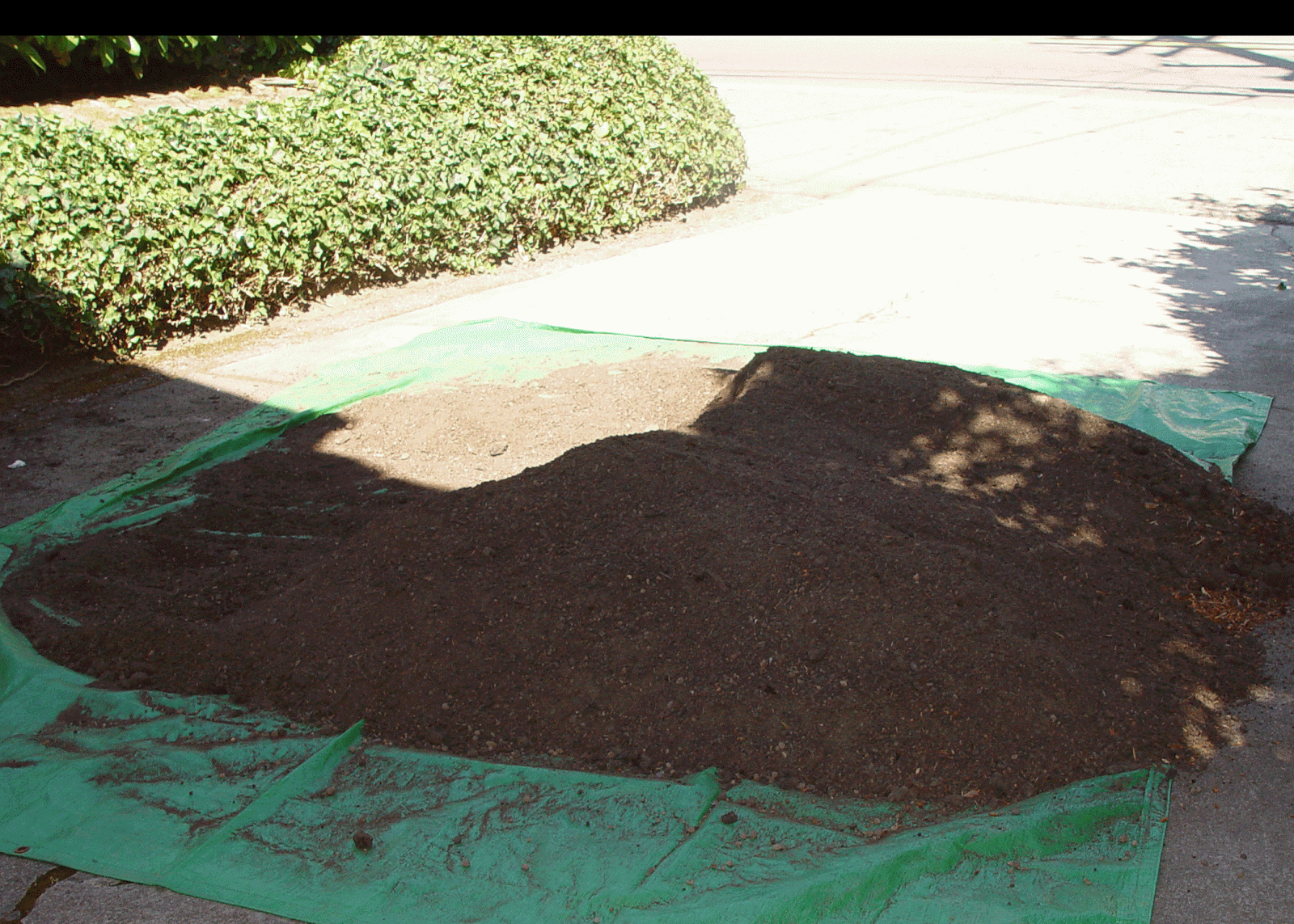
American soil offers several options – you can buy soil in bags, or in bulk; you can use your own truck to pick up the soil from their site, or have the soil delivered to your site. After doing some calculations and weighing the pros and cons, I decided to pay American Soil to deliver the soil in bulk on our driveway, and to provide the woman-power to move all that soil into the raised garden bed.
It took two of us to excavate dirt for the posts,
and move the garden box to its new location.
We used a level to determine its final positioning.

Future proofing - we planned to irrigate using a hose system,
and drip irrigation. But wanted to build in the
potential to tap in to the existing sprinkler system.

American Soil delivered the soil to our driveway in bulk.

We added the soil to the raised garden bed,
and filled in the post holes.
The raised bed is almost ready for planting. Next time - adding irrigation to the raised garden bed.

Saturday, March 19, 2011

Give Peas a Chance

March 17 (Saint Patrick’s Day) is the traditional day for planting peas, but I typically plant them in late May in the San Francisco Bay Area. We usually enjoy peas well into September, when we are experiencing our hot, dry season.
Why are peas so great to grow? Not only are they easy to cultivate and eat, but they can be planted in very poor soil. Peas are in the legume family, which includes nitrogen-fixing plants. These plants “capture" nitrogen out of the air, and “fix” it into the ground. Peas provide their own fertilizer! The plants require rhizobia bacteria in the soil. The nitrogen cycle is one of those beautiful mysteries of the garden.
Last year I planted Super Sugar Snap Peas
from Renees Garden (reneesgarden.com).

We enjoyed peas for several months.